
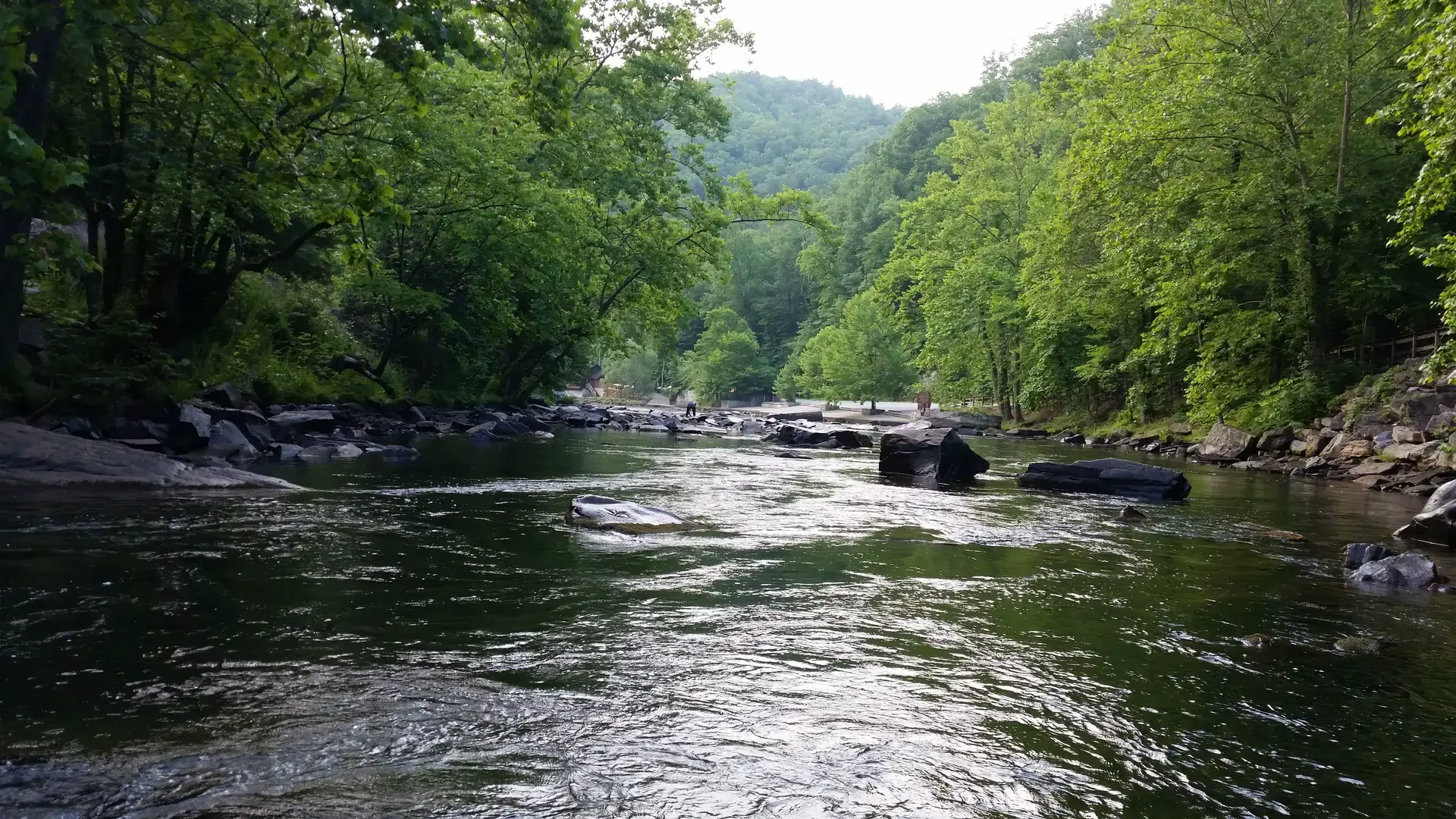
Tuckasegee River · Nantahala River · Great Smoky Mountains · Live Conditions
Smoky Mountains Fly Fishing Report & Hatch Chart — Bryson City, NC
Your essential guide to what's hatching, what's working, and what to expect on the water
Updated Every 15 Minutes — Live USGS Data
Know What's Happening on the Water Before You Ever Leave Home
The Bryson City Area Hatch Chart covers fly fishing conditions, insect emergence, and fly recommendations for the Tuckasegee River, Nantahala River, Oconaluftee River, Deep Creek, and wild streams of Great Smoky Mountains National Park — compiled from 40 years of on-stream data and over 14,000 stomach samples from wild regional trout by Mac Brown Fly Fish. Updated seasonally. The most comprehensive hatch data available for Western North Carolina.
Whether you are planning a trip weeks out or deciding whether to grab the rod this afternoon, the single most valuable piece of information any angler can have is what the fish are eating right now. This page exists to answer that question — built from 40 years of on-stream data, over 14,000 stomach samples from wild regional trout, and nearly four decades of daily observation on the rivers of Western North Carolina.
This is not a guess. It is a record.
“Understanding the hatch is understanding the fish. When you know what's in the water, you stop guessing and start fishing with genuine confidence.”
Live Data · USGS & NWS
Automated River Conditions
Tuckasegee River · Site 03513000
Tuckasegee River
—
—
—
Last reading: —
* Water temp from Oconaluftee R. at Birdtown (nearest sensor)
Nantahala River · Site 03505550
Nantahala River
—
No sensor
—
Last reading: —
Deep Creek · FIMAN Gauge
No USGS gauge on Deep Creek — check the NC FIMAN gauge for live flow data.
Always check TVA and Duke Energy generation schedules before wading the Nantahala River. When in doubt, stay on the road side of the river for safe exit. Above 4,000 CFS on the Tuckasegee — float trips are off. Bank fishing only from safe access points.
Current Conditions
River Conditions
Water levels, clarity, and temperature all play a significant role in fish behavior and fly selection — and all three can change quickly in the mountain environment of the Southern Appalachians.
Water Temperature Guide
Reading the Conditions
Actual emergence dates may run early or late depending on weather patterns. Elevation plays a significant role — hatches finished at lower elevations may still be active in the higher backcountry streams of the national park. Water temperature is the most reliable trigger.
Below 45°F
Midges and small Blue Winged Olives. Nymphing and wet flies most productive.
45–55°F
Early season hatches begin. Quill Gordons, Blue Quills, and Black Stones. Dry fly fishing becomes viable.
55–65°F
Prime hatch season. The most diverse and prolific insect activity of the year. Dry fly fishing at its finest.
65–72°F
Summer hatches. Sulphurs, Cahills, Isonychia, and terrestrials. Evening fishing becomes essential.
Above 72°F
Trout activity slows significantly in many streams. Focus shifts to higher elevation streams, tailwaters, and early morning or late evening windows.
A note on fly selection: Patterns with hot spots, colored triggers, and rubber legs consistently outperform more traditional drab patterns on these streams — a conclusion drawn from years of comparative results on the water. Do not underestimate the attractor element.
Terrestrials all summer long: Inchworms, beetles, ants, flying ants, and small hoppers are active from late spring through early fall and consistently produce fish throughout the warmest months. Never leave home without them.
Bryson City Area
Hatch Chart
Western North Carolina · Great Smoky Mountains National Park
Compiled over 40 years of on-stream data from over 14,000 stomach samples. Use as a starting framework and adjust based on current water temperature and conditions. Caddisflies are the most abundant insect family in this region — over 330 species identified in the surrounding watershed alone. Carry larval, pupal, and adult caddis patterns throughout the year.
| Insect / Pattern | Hook Size | Months Active |
|---|---|---|
| Black Stone | 14–16 | February–March |
| Blue Quill | 18 | February–March |
| Olive Midge | 18–24 | February–March |
| Male Adams | 14–16 | February–March |
| Blue Winged Olive (Ephemerella cornuta) | 12–14 | February–July |
| Quill Gordon | 12–14 | February–April |
| Hendrickson (Ephemerella rotunda) | 14–16 | March–May |
| Red Quill | 14–16 | March–May |
| Female Adams | 14–16 | March–May |
| Dark Elk Hair Caddis | 16–18 | April–May |
| Green Drake (Ephemera guttulata) | 10–12 | April–June |
| Yellow Sally | 14–16 | May–August |
| Light Cahill | 14–16 | May–August |
| Sulphur (Ephemerella dorothea) | 16–18 | May–September |
| March Brown | 12–14 | April–May |
| Cinnamon Caddis | 14–16 | May–September |
| Isonychia | 12–14 | May–October |
| Blue Winged Olive (Ephemerella cornutella) | 18–22 | June–August |
| Inchworm | 10–12 | May–August |
| Beetle (Black) | 12–16 | June–September |
| Ant (Black & Cinnamon) | 16–20 | June–September |
| Flying Ant | 16–18 | July–September |
| Hopper (Small) | 10–14 | July–September |
| Trico | 20–24 | July–September |
| Crane Fly | 8–12 | June–August |
| Fall Baetis | 18–22 | September–November |
| Midge (General) | 20–24 | Year-Round |
Average emergence dates. Adjust based on current water temperature and local conditions. Elevation affects timing significantly.
How to Use This Chart
Cross-Reference, Then Observe
Cross-reference the current month with water temperature and you have a strong starting framework for fly selection. From there, observation does the rest — watch the water surface for rising fish and the air for flying insects, check streamside vegetation for clinging adults, and turn over a few rocks to see what is active in the substrate.
The angler who reads the water and the hatch together — not just the chart — is the angler who consistently finds the right fly. The guided trips and schools here teach exactly that process, and it is one of the most satisfying skills in all of fly fishing to develop.
Plan Your Trip
Best Windows by Season
February–April
Early season hatches, lighter crowds, and some of the finest nymph and wet fly fishing of the year.
April–June
Peak hatch season. The Green Drake emergence alone is worth planning a trip around.
June–August
Terrestrial season and evening sulphur hatches. Early morning and late evening are the premium windows.
September–November
Fall brings cooling water, aggressive fish, and some of the most beautiful conditions of the year on these rivers.
December–January
Midges and Blue Winged Olives. Quiet water, fewer anglers, and fish that are very catchable for those who know where to look.
About This Data
40 Years of On-Stream Data
The Bryson City Area Hatch Report was compiled over 40 years of on-stream data collection from the rivers and streams of Western North Carolina and the Great Smoky Mountains National Park. Stomach samples were collected from over 14,000 wild regional trout using a stomach pump — the results imported into a database maintained and analyzed to produce the emergence averages represented in the table above.
Caddisflies are the most abundant insect family in this region — over 330 species have been identified in the surrounding watershed alone. Every angler fishing these waters should carry larval, pupal, and adult caddis patterns throughout the year in a range of sizes and colors. The caddis is never truly out of season here.
AI-Generated · Updated Daily at 6am ET
Today's Fishing ForecastGenerated from 40 Years of On-Stream Data
Insects Active in October
The Tuck is running at 659 CFS and 64°F — that's a fishable flow but on the higher side, so wade carefully and stick to the inside seams and slower water along the banks. The fog this morning is your friend. Low light keeps fish in the feeding lane longer and suppresses that spooky edge they develop once the sun hits the water. The Nanty with generation off at 70.7 CFS is the better wade fishery today, full stop — tighter wading, cleaner current breaks, and fish that aren't pushing hard to hold position. If you've got a choice, run up to the Nanty this morning.
On the Nanty, Fall Baetis are your primary weapon right now. Size #20–22 BWO soft hackles or emergers fished in the surface film during that mid-morning window — roughly 9 to 11 AM — is where I'd start. The fog will hold that low-light window open longer than usual today, so don't rush it. Underneath, drop a #18–20 Pheasant Tail or RS2 off the bend of a #12 Isonychia nymph as your anchor. The Iso is still in play through the end of October and a big dark nymph drifted through the deeper runs will pull fish that won't budge for anything smaller. On the Tuck, swing a #12–14 Isonychia wet fly through the softer current edges — don't fight the flow, use it.
Best time window today is 8 AM through noon before any afternoon thermal shift changes the feeding behavior. On the Tuck, watch your footing hard at 659 CFS — felt-soled wading boots and a wading staff are not optional at that flow, especially on the slick ledge rock this river is famous for. If you're newer to wading, stay on the Nanty today where the bottom is more forgiving and the current is manageable.
AI forecast — Oct 16, 2:49 AM EDT
This forecast is generated by AI using historical on-stream data collected by Mac Brown Fly Fish since 1987 and current USGS/NWS data. Conditions change rapidly in mountain environments — always verify flows and water temperatures before heading out.
Common Questions
Frequently Asked Questions
What are the current water temperatures on the Tuckasegee and Nantahala rivers?+
Current water temperatures on the Tuckasegee and Nantahala rivers are updated every 15 minutes from USGS gauge data at the top of this page. The Nantahala runs year-round between 45–52°F as a dam-controlled tailwater pulling cold water from the bottom of Lake Nantahala. The Tuckasegee varies seasonally — mid-50s is prime trout fishing temperature. Stop fishing for trout at 65°F and switch to warm water species.
Is the Tuckasegee River good for fly fishing today?+
Check the live conditions widget at the top of this page for today's Tuckasegee CFS and water temperature. The Tuckasegee fishes best for trout when water temps are between 45–65°F. Float trips run well from 500 to 4,000 CFS. Below 500 CFS focus on the freestone streams in Great Smoky Mountains National Park. Above 4,000 CFS bank fishing only.
What is the Nantahala River flow today and is it good for fly fishing?+
Current Nantahala CFS is updated every 15 minutes in the conditions widget above. The Nantahala fishes best for trout when TVA generation is off — typically until noon. Wading is excellent during off-generation periods. Always check the TVA release schedule before wading and stay on the road side of the river for safe exit when generation resumes. Float trips are recommended when generation is running.
What flies are working in the Smoky Mountains right now?+
The AI fishing forecast at the top of this page generates daily fly recommendations based on current water temperature, CFS, air temperature, and 40 years of historical on-stream data from Mac Brown Fly Fish. As a general rule — caddis patterns work year-round on these streams in larval, pupal, and adult forms. In spring key on Quill Gordons, Blue Quills, and Hendricksons. Summer brings terrestrials — ants, beetles, and hoppers. Fall means October Caddis and big browns.
Should I go fly fishing in Bryson City today?+
Check the AI Daily Fishing Forecast at the top of this page — generated every morning at 6am from current USGS flow data, NWS air temperatures, and 40 years of historical on-stream reports from Mac Brown Fly Fish. If water temps are between 45–65°F and the Tuckasegee is running 500–4,000 CFS — get on the water. Spring and fall are the strongest seasons.
Let Us Put You on the Right Water at the Right Time
Forty years of hatch data is a powerful tool. But nothing replaces being on the water with someone who has watched these rivers through every season, every weather pattern, and every hatch cycle that Western North Carolina has produced since 1987.
“The river is always telling you what it wants. The question is whether you know how to listen. We will teach you the language.”