
SMOKY MOUNTAINS · BRYSON CITY, NORTH CAROLINA · SINCE 1987
Spey Casting Clinics & Two-Handed Instruction
Every angler who has ever lost a fly in the trees, stood with a cliff at their back, or watched a fish rising just out of reach has already met the problem that Spey casting solves. A two-handed rod turns the river itself into your casting engine — no backcast required, no room needed, and distances that feel almost effortless once the cast clicks. Mac Brown is the only FFI Master Casting Instructor in North Carolina, a certified casting examiner for Fly Fishers International, and the author of Casting Angles. He has been teaching two-handed casting in the Smoky Mountains since 1987. Clinics run on both land and water. Zero Spey experience required. Classes are taught by our team of credentialed instructors, which includes 2026 Women's World Fly Casting Champion Whitney Gould. Instructors vary by session.
The river does the work. You just have to learn to get out of its way.
What Is a Spey Rod, Really?
A Spey rod is simply a longer fly rod — usually 12 to 15 feet — that you hold with both hands. Instead of throwing a backcast over your shoulder into the space behind you, you use the surface of the water to load the rod. The line rolls up into a shape called a D-loop, and when you sweep forward, that stored energy unloads across the river in a clean, controlled arc.
The practical result: you can cast 60, 70, 80 feet of line in situations where a single-hand cast is completely impossible. Trees behind you? Gone as a problem. Cliff wall at your back? Handled. Fish rising on the far bank that your regular rod can't reach? Now reachable. You are not fighting the environment anymore. You are using it.
There is a common assumption that Spey casting is for experts only — for people who fish salmon rivers in Scotland or chase steelhead in the Pacific Northwest. That assumption is wrong. Spey casting is learnable, it works on trout water right here in Western North Carolina, and the first lesson tends to surprise people with how fast it starts to feel natural.
"The moment a student makes their first clean Spey cast — line rolling out over the water with no backcast — the look on their face says everything. It feels like cheating. It is not cheating. It is just a better tool for the right situation."
Two Paths
Where Do You Fit?
Whether you want to dip a toe in or dive all the way, there is a right starting point for you.
Path A
Private Spey Lessons — Try It First
The right choice if you want to pick up a two-handed rod for the first time, see how it feels, and get honest answers before committing to a full weekend. One hour with Mac is enough to understand the basic cast and leave with something real to build on. Completely private — one or two people, all gear provided.
- Never held a Spey rod — perfect starting point
- Want to try before buying any gear
- One specific problem to work through
- Prefer to go at your own pace
Path B
2-Day Spey Weekend School — We Build It From Scratch
Two full days where we slow everything down and build the right movements from the ground up. No prior Spey experience required — that is the entire point. You start on land so the basic shapes feel natural before you ever touch the water, then you take them to the river and feel them work. You leave with curriculum handouts, a personal written assessment from Mac, and a clear, honest picture of exactly where to go next. All rods, reels, and lines are provided. Nobody is judging your starting point.
- Complete beginners welcome — we start where you are
- Two full days on land and on the water
- Written curriculum handouts you take home
- All rods, reels, and Spey lines provided
Still Casting Hard at 60, 65, 70 — Here Is Why
Here is something nobody talks about enough: Spey casting is genuinely kind to the body in a way that single-hand overhead casting is not. When you cast a single-hand fly rod all day, the same shoulder takes the load on every single cast — hundreds of times, hour after hour. That is a repetitive motion problem, and it catches up with most anglers eventually.
A two-handed rod changes the equation. You hold the rod with both hands and use a sweeping motion that distributes the work across both arms, your wrists, and your core. You are not hammering the same shoulder on every stroke. As a result, anglers who have had shoulder surgery, rotator cuff issues, or who simply notice their single-hand stamina fading find that they can fish longer, cast farther, and feel completely fine at the end of a full day.
Some of the most accomplished Spey casters Mac knows are in their sixties and seventies — and they are reaching distances that stop younger single-hand anglers in their tracks. Age does not hold you back from Spey casting. For a lot of anglers, it is exactly the right reason to start.
What You Will Learn
What We Work On — And What It Gets You
Every skill in the curriculum has a direct payoff on the water. Nothing taught for the sake of teaching it.


How Mac Teaches — Feel First, Talk Second
Spey casting is a physical skill, and physical skills are learned through feel — not through a lecture on geometry. Mac does not stand on the bank and recite rules. He watches you cast, finds exactly where the movement breaks down, and gives you one simple fix that your body can actually do right now. Then you do it again. Then again. The cast improves before you fully understand why — and the understanding follows naturally.
Weekend clinics start on land deliberately. No moving water, no fish to distract you — just the movements. Once you can feel the rod load and unload cleanly in a field, moving to the river becomes straightforward instead of overwhelming. Mac has been teaching this sequence since 1987, and it works.
Every student is built differently and moves differently. No single rigid stance or technique is imposed on anyone. What works for a six-foot-two former college pitcher is not what works for a five-foot-four retiree who has never thrown anything overhead. Mac adjusts to you, not the other way around.
- Start on land — nail the movement before adding moving water
- Mac finds what is wrong before telling you how to fix it
- Every drill is simple, repeatable, and something you can practice on your own
- Honest feedback — including what you are already doing well
On Our Instructor Team
Whitney Gould — 2026 Women's World Fly Casting Champion. Overall women's world champion at the 2026 World Flycasting Championships in Vinadio, Italy (four gold medals) and eight-time Spey-O-Rama women's world Spey casting champion.
Instructors vary by session.
Questions
Frequently Asked Questions
Location & What's Included
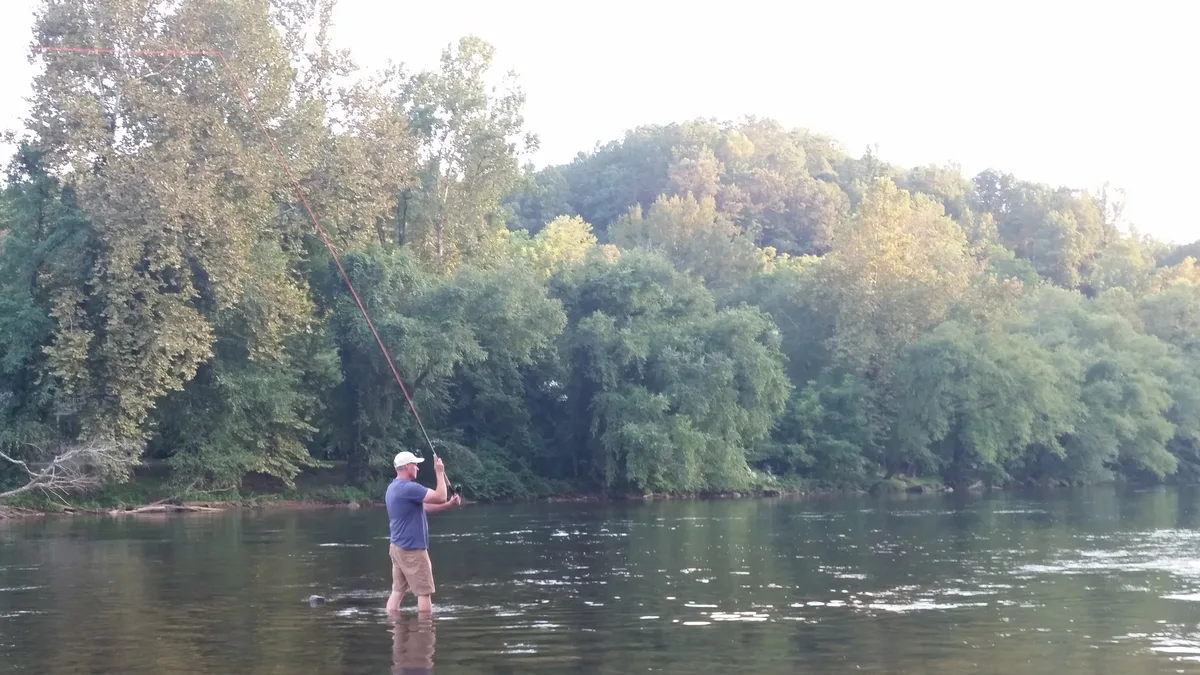
All instruction takes place in and around Bryson City, North Carolina — in the heart of the Great Smoky Mountains. Weekend clinics begin on land in a field or lawn setting, then move to the Tuckasegee River, right in Bryson City, where the wide open runs give you room to make real casts and put the movements into practice.
All tackle is fully provided. That means matched two-handed rods, Spey reels, and specialized Spey lines — everything you need to cast properly and learn what you actually like before spending a dime on gear. Bring your own setup if you want instruction specific to your equipment, but it is never required.
Ready to Start
Try It Once. You Will Understand.
One private session is enough to feel the difference. Book a lesson, ask a question, or get honest advice on which path is right for you.