

Standardization in Fly Casting Today
Standardization of fly casting today may lead to stagnation over time. To evolve into the future, the sport must address the need for better instructors who teach why and how casting actually works. There are many examples of various styles out there today, yet mechanics rule all of them. In my travels fly fishing over the years, I have observed that there are two types of anglers. First, the most popular category is what we refer to as recreational anglers. Most of us came out of this "mold," if you will. For me, my grandfather introduced me to angling at around four years old. For many, they remain recreational anglers throughout their life. Fly fishing takes us to beautiful places with people we enjoy being with on the stream.
This group often looks for shallow answers to complex topics. The preferred techniques used on the water may include lobbing a bobber, a tight line rig, a cast that fails to make the distance (even short distances), or that twelve mile-per-hour wind that they just may not overcome on the saltwater flats. The industry feeds the recreational angler sayings like "fly fishing is so easy," rules, principles, and other oversimplified models to follow. Rules are usually driven by someone's ego in the long run and become commonly repeated as if they are the "gospel of fly casting." This is a dangerous path that neglects the simple principles of basic mechanics—topics that my boys have already covered in elementary and middle school. The key is applying mechanics combined with logic to grow in understanding and kinesthetics for your journey.
"Learn to close the gap between imaginary perfection and imperfect reality by practicing between education and the execution of the fundamentals" – Mark Surtees

Advanced Fly Casting Class on the Road
This approach often leads folks into a "rabbit hole" of stagnation. This is not a pleasant place to remain because stagnation implies frustration. The self-taught fly fisher takes the long detour around the sport. You know the person who wants to figure it all out on their own. They might even commit to the free parking lot lesson at their local fly shop. All of these "free offerings" may or may not be worth your time. Just think about it: does Nick Saban coach the University of Alabama year after year to national championship games for free? His value comes from monetary compensation. There might be thousands of folks who want to coach such a prestigious program for free.
Commitment to Improve
The small sliver of society that really wants improvement is committed to getting better. The dedicated fly fisher who "commits to improvement" is the second type of angler. They want to improve in all facets of the sport. They typically are not content with the entertainment aspect of the sport because they value education. The educational approach will never fit into the mold of the bell curve of recreational anglers. They get help from someone who can deliver coaching and mentoring. This may save decades of wasted time going at it alone. I get asked often on the road how long improvements in fishing techniques and casting may take. It is my belief that it varies from person to person, depending on their commitment and how driven they are to get better.
"Often attempted, usually neglected, and rarely perfected" – Mac Brown
Many tasks are often attempted, usually neglected, and rarely perfected. You cannot change the fundamentals of skills such as shooting line, hauling, accuracy, and many others. You cannot change the rules of mechanics that limit or assist in launching you further as a fly fisher. The only thing you can change is yourself and how you approach the game of casting. For some, they can perform kinesthetically without really having an understanding. Kids fall into this nicely—they can form nice loops in short order with simplistic instruction. For cerebral casters, they may understand it well, yet there is a lag in the kinesthetics due to insufficient myelin developed through repetition.
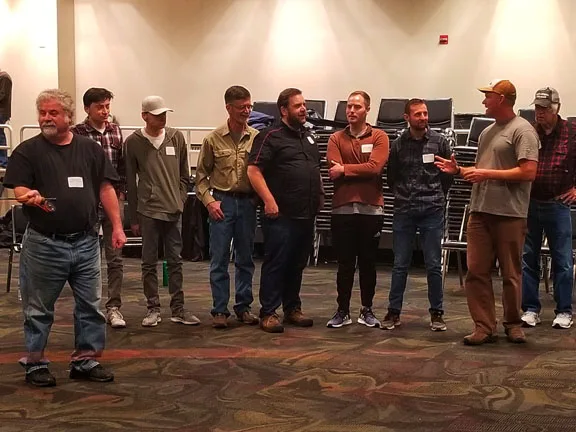
Class in Session on the Road for the Advanced Fly Casting Class
Legends in the Making
There have been many young people who came through the Team USA Youth Fly Fishing team clinics who achieved World Championship status in short order. Many folks invested time with these young people, and they became very proficient in less than three years. The first youth world champion was Norm Makatima, who was mentored by Davy Wotton. My own kids, Connor and Duncan Brown, started fly casting at two years old with proper technique. Chris Korich has done a phenomenal job with Maxine McCormick, who has won all types of gold medals in the world championships. She has set the bar so high that I doubt it will be broken for a long time. Other mentors to me as a kid did the same with their own children. Jason Borger was around casting all the time and was taught by his dad, Gary Borger, during clinics. Doug Swisher, who also penned many great fly casting books in the 1970s, taught his son Randi Swisher. Steve and Tim Rajeff had an impressive introduction at the Golden Gate Casting Club at fourteen years old with Mel Krieger. Were these iconic figures self-taught?
One of the finest moments all winter long at shows on the road was watching Gabe Wittosh casting in Atlanta, Georgia. His casting was fantastic—something he developed through his years competing for the Team USA Youth Fly Fishing Team. He is driven and has practiced for many years to attain these skills. He put on his own show on the "pond hog" pool with static roll casting over the end of the pond with ease. When recreational anglers see that, they gather around quickly. It was brilliant to see the efforts of years ago paying off big today. Great to see him and his family while there in Georgia.
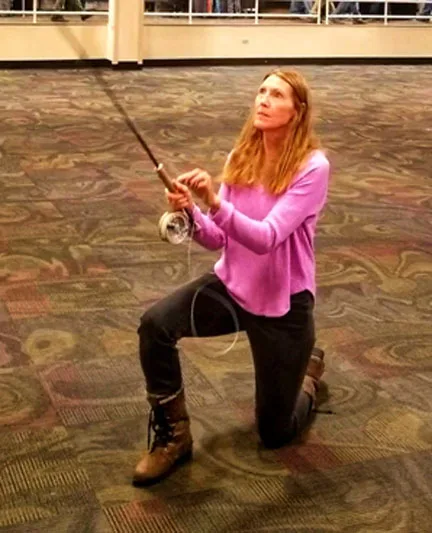
Carol Perfecting Her Default Stroke During the Fly Fishing Show in Denver, Colorado
Which Train Are You On?
Anyone can get on the train to improve in short order and prevent spinning in circles down the same track. Get youth into the sport at a young age because they are quick to teach, as are women. Men have a bit of a disadvantage in the early stages of learning to fly cast because they are indoctrinated with projectile sports. In fly casting, we are dealing with a loop of line that is accelerating the fly. In throwing sports, to go further means throwing it harder. So the basis of efficient fly casting has to break the mold that more power is always better. We try to get the student to appreciate the concept that "less is more" when teaching how the loop unrolls.
Those who seek the value of education to raise their skills want to become proficient. This path requires practice on your own. I have thought for years about how to motivate fly fishers. Part of this dilemma is the "imaginary perfection" that recreational anglers remain stuck in for a lifetime. There are hundreds of examples in our sport of fly casting. The shooting line technique is common when fishing. The majority of recreational anglers would perceive their abilities and feel as if they are skilled. Yet proper technique may shoot forty feet of line while the recreational angler is still at four feet. This task requires practice and a work ethic to improve. If it remains incomplete for decades, it will hamper your abilities on the water.
Social Media
Recreational anglers buy into the overwhelming information highway. Think of the tips and tricks from the worldwide web: YouTube, Vimeo, posts of exotic fishing destinations, or that elusive "magic fly." I have often wondered why people choose this route when they do not yet have the knowledge to discern good from bad information. This is another "rabbit hole" of spinning your wheels full of unnecessary sayings, rules, principles, and concepts that may or may not lead you to where you want to be.
The late Lefty Kreh told me that he believed ninety percent of the recreational community would not benefit whatsoever from buying a thousand-dollar rod. I do believe this statement to be true. Take the top five percent of elite casters, and they will cast the cheapest of outfits well. So there are real skills to master: learning proper rod load, shooting and hauling the line, curves, mends, and more—all of which match your intent while fishing. Improving your skillset is all about you and you alone. If you really develop elite proficiency, then I assure you that you will have a more satisfying experience actually fishing.
The first step is to separate your line control practice into grass and water sessions, actually practicing casting. Most guides have to make do with whoever they have throughout the year, and I can assure you the bar is lower today than ever before. Just watch the efficiency of one's actions on the water—if they minimize the number of steps and prevent unnecessary false casts. standardization fly casting
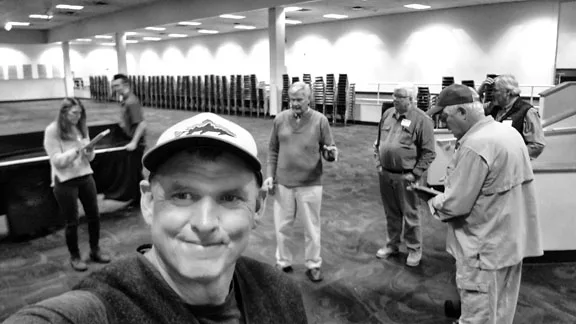
Students Taking Notes During the Advanced Casting Class in Denver, Colorado
Remain a Student of the Circle Game
The more you know, the more you do not know. When we think we know something, we end up deluding ourselves. Draw a small circle; the thin line around it is the border of all the new areas we could learn something new. Now draw a circle that is twice as large. That thin line of what we do not know has increased by 3.14 (pi). This is a fascinating journey when we remain flexible and keep pushing forward. Thanks to my father-in-law Jerry Jennings for the concept of the circle game used in education. He has taught psychology at Berry College for many decades. It often leads us to more questions than answers at times. It is natural to have peaks and valleys with the relationship of understanding and the action of doing it. The joy lies within the journey always—not in an endpoint or destination. standardization fly casting
It is for this reason that remaining a student of the game makes life interesting. It raises the bar for your personal skills while exposing you to new areas that you might want to discover through exploration. Those who remain in the simplistic view of rules and principles that break down lack the ability to grow. Standardization in fly casting today will always be around, so the real question is how long will you hold fast to these false beliefs? Remain the farmer planting seeds for growth to evolve and flourish ahead during your journey.
"Every time you double your knowledge on a subject matter, you introduce three times the information that you do not know"
I have loved teaching the classes on the road and the clinics in Bryson City, NC, since 1987. Facilitating this process with students from all walks of life who are interested in moving ahead is exciting. It also solidifies that those going in circles who remain stuck in stagnation are not my people—until they wake up and seek more. Looking forward to the last few fly fishing shows of our winter month class series in Pleasanton, California (2/20/20) and Plano, Texas (3/20/20) and the two-day advanced fly casting class in Bryson City, NC (3/27–28/20) (click the links for signups). It has been a great winter working eight of the largest cities in the country and evolving the sport so far. I'm excited to be going to the home of the Golden Gate Casting Club with their rich tradition in our sport. This region influenced me as a kid with Jim Green and many other greats who raised the casting bar for the world. It has been a great experience teaching with Gary Borger over the winter and incorporating some new concepts into our programs. standardization fly casting