

Positive, Negative, & Constant Rates of Movement
To understand rod acceleration and, more importantly, apply it is the greater skill. For many decades, good-intentioned casting instructors have inadequately addressed only the concept of constant rod acceleration. Using only constant rod acceleration may or may not be appropriate depending on your goal for line and fly layout.
As I compiled in my text, Casting Angles, I used a simple graph that showed negative, constant, and positive force to convey the acceleration needed to create the desired layout. Mastering all three rates will give you the control to perform many types of fishing casts, regardless of the circumstances you face.
Imagine rolling a small matchbox car across a tabletop. You give it an initial push, and the car positively accelerates. Somewhere near the halfway point, the car decelerates to a stop. This simple analogy helps you understand the motion you impart to a fly rod. It also demonstrates the higher level of fly line control: YOU are in control of negative, constant, and positive accelerations to dictate the end result of your fly line intent. This is what is meant by line and fly presentation—the grail of fly fishing.
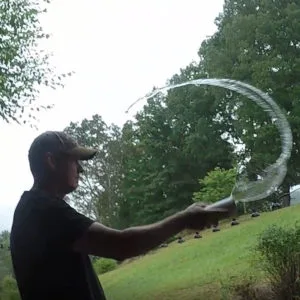
Forward Water Shaped Loops Are Formed by Proper Rate of Arm Movement with Stop (click for YouTube video)
Loop control uses many types of accelerations, and that's what helps create many different types of layouts. This optimal control allows you to solve each casting and layout situation and develop your bag of tricks. Sometimes the cast and line need to go straight upriver, sometimes curve right or left, and other times the line may go around an obstacle. You might want the line to puddle in front or have S-curves in the layout. Sometimes the fly needs to be tucked in and driven straight down deep. Other times it may be tucked in so lightly that a weighted fly hits the water as if attached to a parachute. As you can see, the list can become lengthy when mastering line control.
Disappointingly, most highly technical papers on fly casting focus only on getting the fly line out there with no control over the desired result!
Acceleration exists in three forms: negative, constant, and positive. These three varying amounts of acceleration will change the rod load. Think of rod load as being able to engage different sections of the rod. The simplistic approach is to imagine bending it from a tip-flex cast all the way to the cork handle. What rate of acceleration enables you to cover this spectrum? All three are used in fishing casts!
During a lesson, conveying the rate of movement for a particular acceleration is usually the most difficult aspect to fix. Most casters use too much acceleration. Back off and think smooth application, and chances are you'll have a light bulb moment!
Acceleration
It sounds a bit technical to convey the concept of acceleration in fly casting instruction. What is it? Basic mechanics address position, velocity, and acceleration thanks to Sir Newton. A change in the rate of velocity over time is the acceleration of an object. It is well known among many tournament casters to engage the butt of the rod first by using larger muscle groups. The classic vertical stroke, which has been around since 1854 in tournament casting, is a good example of this. The shoulder lifts and the elbow points forward at your target. This lengthens the stroke and assists in creating nice loops for the backcasts.
Is this motion always constant acceleration? No. Yes, the early stages of the casting stroke may be constant acceleration. However, every elite fly casting peer has some amount of jerk with respect to the fly line as they hit an increase in speed near the rod hand stop.
Loop Control in Fly Casting
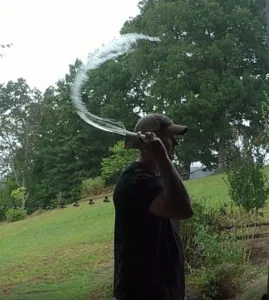
Back Cast Water Shaped Loops Illustrated by Proper Rate of Arm Movement and Stop
The path and rate at which you move your arm help create the shape of the loop. Think of throwing water from a cup. A paintbrush illustrates this well to new students. Having them flick water from a brush helps them understand the path, rate, stop, and ultimately the trajectory of where the water travels. Mastering acceleration empowers both students and instructors with greater line control.
Unfortunately, many images on the internet use narrow and wide loop diagrams and talk about the clock face instead of addressing the concept of various acceleration rates. Global casting groups' mantras about the necessity of a straight tip path with a flexible rod are misleading.
Loop control is more in-depth than just viewing a clock face diagram of rod positions. You, the fly caster, tweak various amounts of arm movements—like a kinetic whip—to transfer energy to the rod, which ultimately transfers this energy to move the fly line. You must practice often in the early stages to perfect your rates of movement and increase your efficiency in fly casting.
It's difficult to ignore the rate of movement when teaching because it's always necessary for a better understanding of rod loading. Correct rod loading dictates loop control. That's what fly casting is all about: unrolling a length of line to a target!
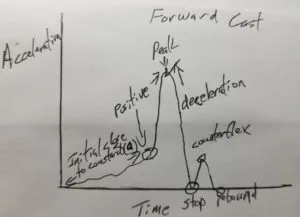
Similar to graphs produced from the Casting Analyzer illustrating the many rate changes of acceleration during the forward cast. (click for video)
Jerk
Jerk implies a change in the rate of acceleration over time. In fly casting, it's important to remain smooth with your casting motion while still changing the rate of acceleration!
Fly casting distance can be thought of as lots of speed, much like a crescendo in music! The main goal is to maintain a flat fly leg that travels fast with the proper trajectory. Timing is critical—the haul, stop, and rod unbending must occur simultaneously.
We build into the crescendo with explosiveness in the haul, rotating very late, and the spring effect of the rod unbend. The Whole is Greater than the Sum of its Parts. First coined by the philosopher Aristotle, this phrase aptly defines the modern concept of synergy.
Rates of Movement in Summary
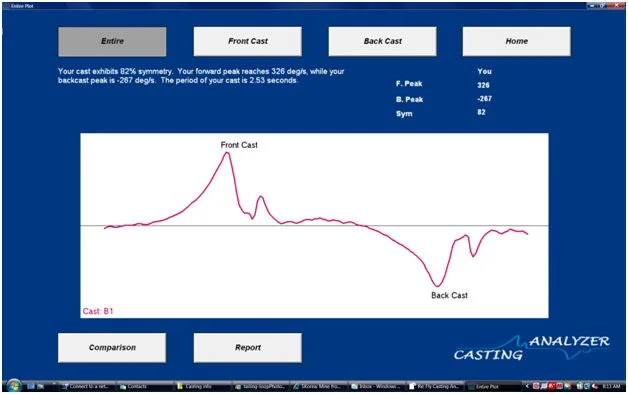
Rate changes of acceleration during the forward and backward cast. (click for video)
To apply these various rates of acceleration means establishing varying amounts of rod load depending on your intent. One of the problems I've encountered in teaching casting for over 35 years is that usually, folk's practice sessions aim simply to get it out there. Your practice intent should deviate all over the spectrum, using various amounts of accelerations and decelerations. Tip, mid, and butt flexed casts all yield different line layouts for varying presentations.
One of the best training practices is to learn to appreciate throwing as slowly as possible to gain an understanding of just how minimal it really can be. Happy fly flinging.