

FFI Expo Crystal River, Florida Fly Casting Peers Pete Greenan, David Lambert, Jon Cave, Mac Brown
The 5 Essentials of Fly Casting were introduced by Bill Gammel in Texas in 1990. The Essentials can assist folks learning to fly cast and provide instructors with key language when performing a fly cast. They offer some of the first mechanics for describing a straight-line cast, which is great for teaching accuracy and distance. Fly Fishers International uses the 5 Essentials of Fly Casting for its certification programs, which include certified instructors, master casting instructors, and two-handed casting instructors. The benefit is that instructors establish universal, congruent language.
I started teaching fly casting in 1987 in Western North Carolina. My challenges come from problems I encounter on the water—primarily working around obstacles and water currents to achieve my desired presentation. Teaching offered a huge learning curve for conveying concepts to students, and it inspired me to compile my book to share what I had learned with others. Three decades later, my learning curve continues to increase. Learning to read people, improving my knowledge of mechanics, and building better word pictures are where I believe growth continues. It takes practice and time for students to truly appreciate that less is more!
Here are the 5 essentials of fly casting, which will benefit you as a fly casting instructor. Power must be applied in the proper amount and at the proper place during the stroke. There is a pause at the end of each stroke, which varies in duration with the amount of line beyond the rod tip. Slack in the line should be kept to a minimum. The rod tip must follow a straight-line path. The casting arc is variable and increases with the length of the line being cast and/or tempo.
Modified 5 Essentials in a Sentence
"Begin with the fly line under tension, applying rates of movement using proper timing along an intended rod tip path through the appropriate rod arc." This one sentence sums up the intent of forming nice loops for all skill levels. Applying it while teaching makes it more simplistic and inclusive for describing all casts. I use it often in lessons by emphasizing key points to match your intent. It has served me well for explanations in teaching FUNdamentals for many years.
Tension
Waving a string is all about the manipulation of tension. All fly casts have varying amounts of tension depending on your intent. The 5 Essentials are great for teaching accuracy and distance, but there is also more! I teach pause, power, and path for any type of fly cast during a lesson. Power is a rate of movement. These three things take care of everything else during a casting cycle for all casts! If students learn to alter the power and path for fishing casts, they are well on their way to controlling the layout in fishing scenarios. Remember, less is more for students of casting.
If you choose to teach fly casting often and pursue this path, it will be essential that you can explain and demonstrate more than simply distance and accuracy. Fishing casts are often not straight, so the intent has changed. Change-of-direction casts and constant-tension casts also fit nicely into this category of fly casts. Go ahead and wiggle the rod tip during the cast! How did that motion vary the layout? When you apply acceleration to the rod, it is perfectly fine to have multiple rod tip paths during the overall stroke. For the casting geeks, we are saying many force vectors can be applied as a result. An intended rod tip path tends to work nicely for both new and advanced students.
If your intent is to manipulate transverse waves for controlling a layout with curves, you will need to adjust the power and path. The easiest thing to convey during a lesson is that the path of the rod tip during the loading move will show up in the fly leg of the unrolling loop. When you alter the rod path after the loading move (power), you influence the rod leg of the loop. How cool is that? Understanding why the fly line reacts to your efforts comes down to you, the caster. You have to appreciate the good, bad, and the ugly in your practice sessions! They all will give you a deeper understanding of fly casting.
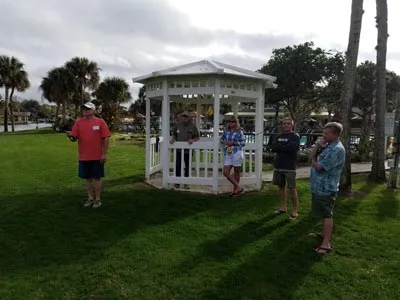
Crystal River, Florida FFI Expo Fly Casting Class
Practice
We live in an era that promotes achievement without practice. I'm not sure why so many are content to remain mediocre. It's disturbing, since there are some really great instructors globally. Your overall enjoyment of fly fishing will increase with lots of practice in the beginning. Every sport has athletes constantly practicing and seeking incremental improvements over time. Golf pros seek lessons from other pros gifted at swing diagnostics. Football players hit the gym for training. Most fly fishers try to learn fly casting on the water rather than get the basics on grass first. Fly fishers can all be broken down into two categories: those who seek only entertainment value, and those on an improvement journey. It's all about you!
Many old fly casting mantras produce fly casters who become stagnant and lack the skills necessary to reach the next level of presentation. I believe the benefit of exposing new fly casters to a foundation of pause, power, and path from the beginning is significant. This foundation leads to an understanding of loop shape, line speed, and loop plane for all fly casts that exist in fishing scenarios. The proper foundation enables the growth and evolution of greater presentational fly fishers! This empowers them to practice many things on the grass first for matching the conditions at hand.
You can be the greatest distance caster on the planet and have no game whatsoever if you cannot present with intent to match your surroundings (obstacles) and water currents (layout for drift). Practice getting better fly casts with many drills. Check out the itinerary at the fly casting training classes to get an idea of what is available.