

Thoughts on articulated sculpin patterns
Articulated sculpin patterns work best depending largely on conditions and water types. I prefer tying articulated sculpin patterns in olive, brown, and black. The pic above shows a brown trout caught on the lower Nantahala River on a sculpin pattern in 1988. There are some great new patterns available today with specialized hinges from companies like Flymen. Fish Skull heads make adding weight a cinch for realistic sculpin heads. Today's materials also offer fly tiers so many choices with UV colors, action, and weight when putting streamers together on the vise. Kelly Galloup has many very productive streamers that take advantage of these materials.
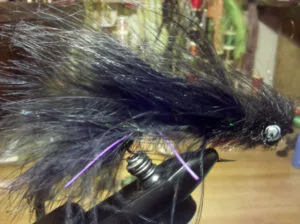
I had a blast discussing pattern triggers, materials, and tactics late into the night when Kelly was here in the fall. Big flies consistently produce more quality fish, and this last summer was no exception on the Nantahala River with its fantastic wild brown population. The show "Big Mac Browns" aired first on 2/14/2011 (FFTV on Versus) with footage of Kelly's visit here to Western NC. Over the past few years, I've been experimenting with foam butts and heavy front hook sections to emulate feeding sculpins that burrow into bottom structure. Here's a pic of one in black that sinks heavy in the front while the rear action undulates up and down.
The Wire Attachment for Articulation
The articulation uses 20 lb. wire with two beads positioned very close to the front hook. The wire must run up and down through the two sections, or the action will suffer (in other words, when you fold it through the back hook, keep the top on top and the bottom on the bottom). You can find braided stainless wire at craft stores like Michaels. Other ingredients include black wool, black marabou, black craft fur, olive sparkle chenille for the underbody, foam in the rear hook, lead and tungsten in the front section, and doll eyes on the wool head in front.
Another thing that triggers strikes is the profile once it's wet. The back section has lots of action and tapers nicely when wet (mostly marabou). The front section creates a bigger profile with craft fur, then marabou, and a thick black wool head. This is the type of pattern I use when targeting really large trout on my home waters like the Nantahala. articulated sculpin patterns
Single Hook Streamer
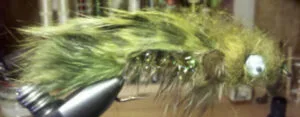
This last pic is an olive sculpin tied on a 4XL number 2 streamer hook. It uses an olive rabbit strip with black Sharpie stripes. Another feature of this fly is the grouse shoulder feathers treated with Clear Cure Goo to provide flexible stiffness, which assists in a wobble action and moves lots of water for a big acoustic footprint. It uses 72 grains of lead and tungsten for riding bottom structure, olive sparkle chenille, olive marabou in the tail, dyed olive barred rock wrapped over the chenille, and an olive wool head built up bulky in the front section.
A general rule of thumb is that when it's really bright out and the water is clear, get your streamers near the bottom of the river for the best results. You can build custom lines by splicing Scientific Anglers' Streamer Express line choices to a thin floating line, which makes a fast sinking line. It's not uncommon for me to throw 300 to 400 grains of sink tip on the Nantahala River when the water is on due to generation. Since sculpins are bottom dwellers, most of the time I use heavy sinking lines to fish them on high water.
When light conditions are low—like on overcast days with dirty water—the best results come from fishing darker flies nearer to the surface. These are usually attractors that represent baitfish other than sculpin. Use a clear, slow sinking intermediate line for stealth. Happy stripping and tight lines!