

Comprehensive University Tippet Study
The following tippet study took place at the MSU and WCU materials labs back in 1996. I was fortunate to have access to the materials lab when I taught the fly fishing programs at Western Carolina University. The comprehensive university tippet study began with some simple assumptions about the gear we use in the stream. We wanted to learn some new things about mono and prove some hunches along the way. comprehensive university tippet study
This seemed of utmost importance at the time since fly fishing is serious business! The information includes data from the studies. Many of the attributes for testing would be similar if I were to do them all over today! Huge thanks to all of the product manufacturers whose materials you see on the pages below that were so graciously donated for this cause.
The study was conducted because all brands of mono are far from being created equal. I had my suspicions for decades as to why some were a waste of valuable money. The tippet is the weakest link between you and the fish. On the stream, I had seen certain monofilament fail consistently from multiple clients, while certain other brands remained much higher quality. It really boils down to quality control of what many companies decide for market-ready leader material. One material that I use often on the water is Stroft mono.
Knot Breaking Claims
Many knot books claim certain breaking strengths for particular knots. For example, many inferior monofilaments break far away from the knot. Does that imply the knot is 100% effective? You have to have a clean section of mono during the extrusion process to even begin a knot study. The findings are listed below.
The tippet study was designed to test varying brands of material for the force required to break the tippet with different knots, the specific gravity of the material (how well it floats), elasticity (amount of stretch), the diameter of the material (micrometer tests for size), and surface finish. The tippet used for the study was 4X (.007" inch).
Match the Mono to the Situation
Your decision about which brands to purchase will depend on the fishing conditions you encounter. For most trout fishing, abrasion resistance is a minor concern compared to knot breaking strength, size, and elasticity (stretch ratio). The advantages of increased abrasion resistance may influence your decision if you encounter sharp rocks or coral reefs. Nymphs and wet fly anglers may prefer fluorocarbon because it sinks.
Another attribute of fluorocarbon is that it stretches but does not recover to its original length under heavy loads, such as when landing larger fish. It is well worth taking a second to tie a new knot after playing a larger fish. Regular monofilament (co-polymer nylon) stretches and recovers more than fluorocarbon and actually holds knots better overall. It is my first choice when dry fly fishing.
Elasticity
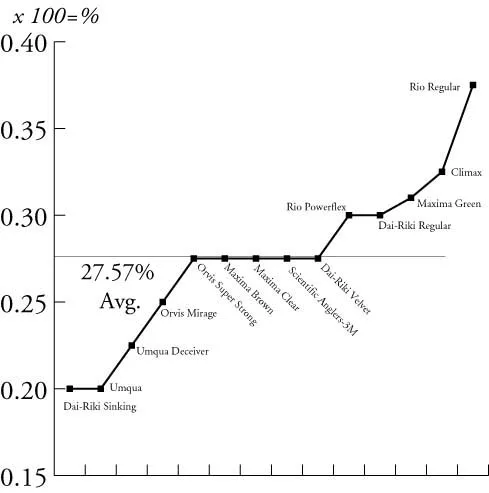
The elasticity test was conducted by attaching 20 cm of material into gripping jaws and stretching the material at a rate of 50 grams per second until failure. The supple materials achieve a greater stretch ratio before breaking. The hard mono achieved a lower stretch ratio (this includes fluorocarbon materials). In general, the harder materials achieve greater abrasion resistance at the expense of breaking more easily. comprehensive university tippet study
Diameter
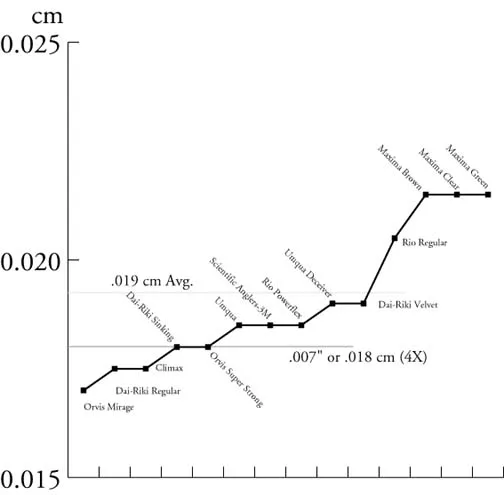
The diameter results of the various tippets were performed with a Welch Scientific Company micrometer. Six readings were taken at different locations on each tippet sample and averaged. All of the tippets claim to be .007" inch (or .0178 cm). Maxima's claimed 4X has the largest diameter—it actually measured 2X (.009"). It tests well when compared with the other brands, but keep in mind that if we tested a leading tippet from another manufacturer of the same size, the results would vary.
Actual Breaking Strength
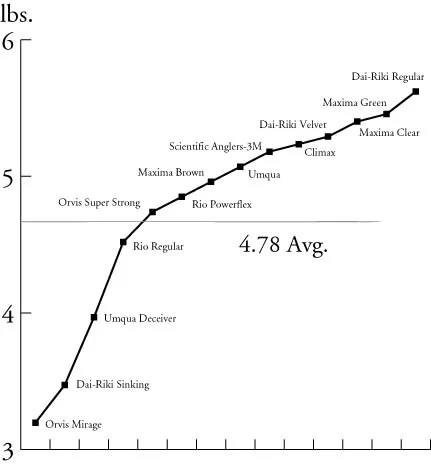
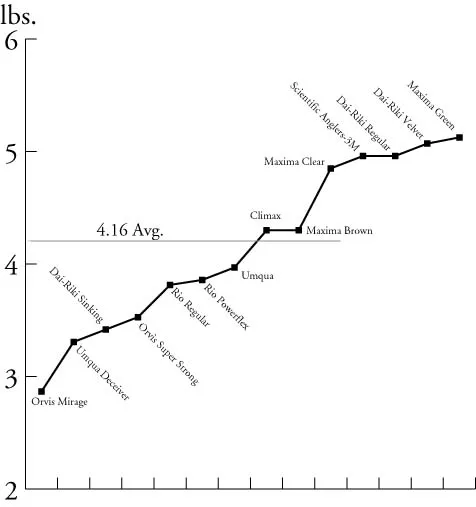
The figures are calculated by pulling the material apart at a rate of 50 grams per second. The spring scale manufactured by Enrich Inc. measures the resistance at the point of material failure. Make sure that you review the knot data before basing your decision to purchase. This is because the brands will all hold certain breaking strengths at varying percentages. For example, you may have one material that tests at a high breaking strength, yet it holds knots at a decreased percentage compared to other brands.
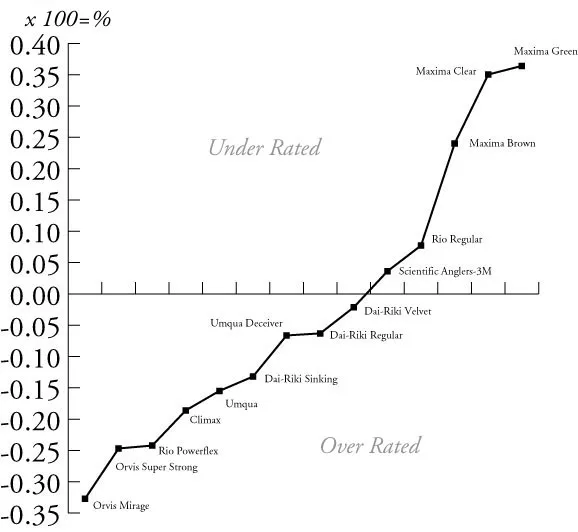
This graph illustrates the percentage difference between actual versus claimed breaking strength. Currently, there is no standard of compliance for these types of claims.
Specific Gravity
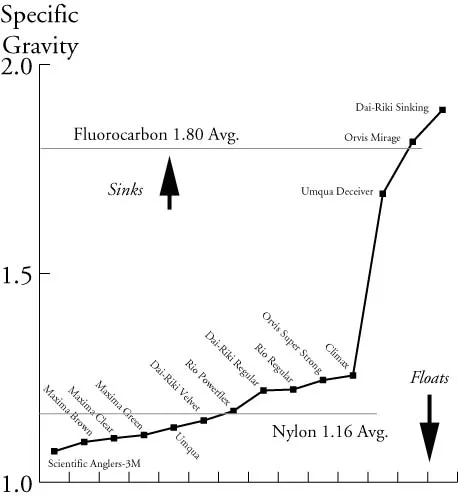
The lower the number, the more the material will float higher or longer on the water's surface. The higher the number above one indicates a material that will sink quickly when placed in water—typical of fluorocarbons.
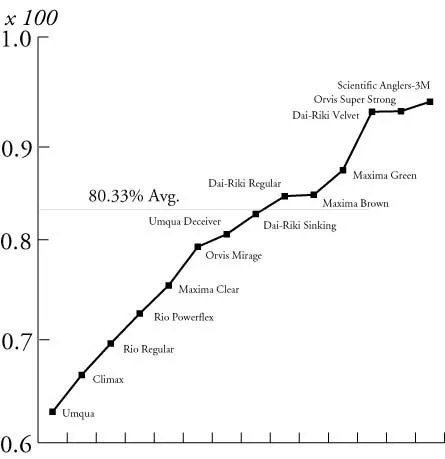
Wind Knot
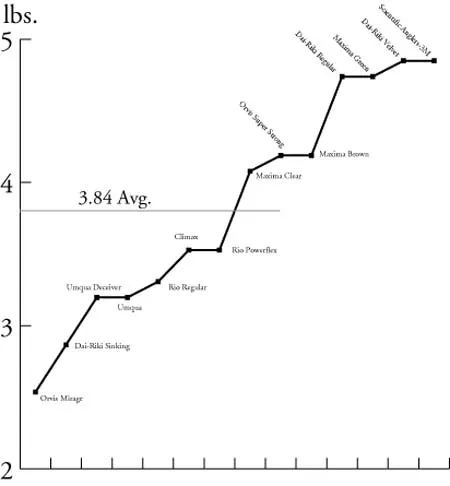
The "actual" breaking strengths varied from "claimed" breaking strengths. The average wind knot breaking strength for all of the materials combined is 80.33% (graph below).
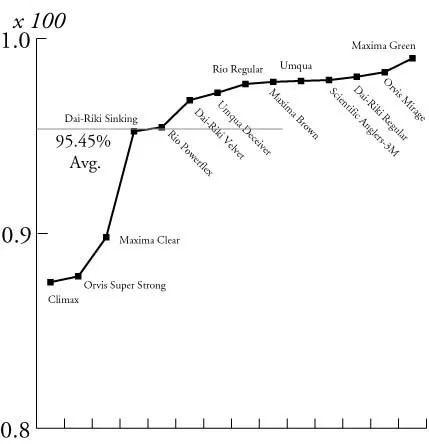
Perfection Loop
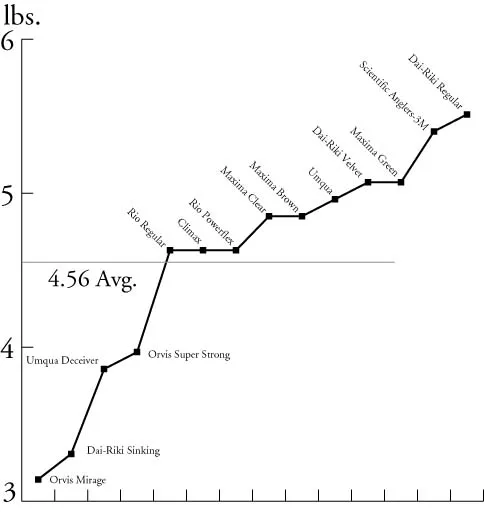
The average perfection loop breaking strength for all of the materials combined is 95.45%.
Triple Surgeon's Knot
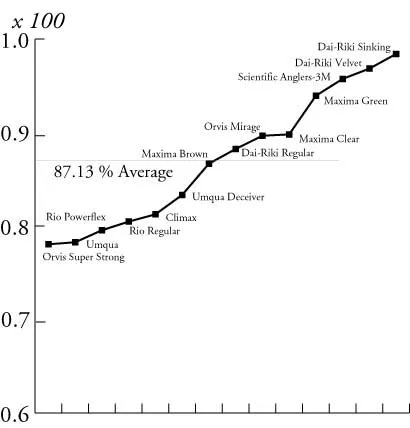
A triple surgeon's knot is commonly used for joining sections of a leader. The average triple surgeon's knot breaking strength for all of the materials combined is 87.13%.
Surface Finish
A clean, mirror-like surface finish will help maintain a higher breaking strength for all knots (see the picture at the top of the page). It also helps reduce the rate at which nylon absorbs water. The picture (Scientific Anglers) is magnified about 350 times, courtesy of Ramsey Greene, MSU materials lab.
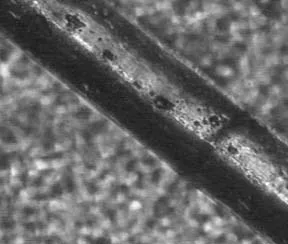
A crater-like surface finish will reduce the overall breaking strength of the material, especially when there are lacerations across the cross-section. It also increases the rate at which the nylon absorbs water, which causes it to weaken. The picture (Cortland) is magnified about 350 times the actual size, courtesy of Ramsey Greene, MSU materials lab.
A Mono Picture Is "Worth a Thousand Words"
Often you will read that a knot holds a certain percentage of the line's strength. They are all different! The extrusion process may vary the surface finish depending on temperature, air pressure, and many other factors. Look for the brand that holds the highest breaking strength when comparing the different knots.
In general, tippets that have a lower breaking strength in the supple nylons will also fail early when used on the water. This is because the surface finish looks similar to pictures of craters on the moon's surface. When nylon becomes wet, the lacerations (crater appearance) in the material soak up water. This process further reduces the strength of the material by as much as 30%. A material will fail even quicker when saturated with water. The surface finish will be a great indicator for judging quality.
Conclusions with Types of Mono
Fluorocarbons typically offer a higher specific gravity (sinks quickly), lower breaking strength for all knots, and better abrasion resistance—which may be important if you have many obstacles in the water. Fluorocarbon also offers a slightly lower refractive index when compared to regular nylon (does not reflect light as much). Many claim that fluorocarbon is invisible to fish (not a chance in my opinion). It also costs around three times the amount of regular mono.
Regular mono typically has a lower specific gravity (floats higher), higher overall breaking strength for all knots, and a slightly higher refractive index (slightly easier for fish to see). Regular mono comes in hard and soft nylons. Use the elasticity chart above to make this decision when choosing your material. Both offer advantages for certain types of waters.