

Fly Line Loops & Accuracy
Fly line loops and accuracy are important components when teaching fly casting. I just returned from a great weekend at the Atlanta Fly Fishing Show and arrived home to a winter wonderland! This article is intended more for the general angler than the loop morphing instructor article published a few weeks back. Hopefully, you'll find a few gems to help improve your own casting. Eventually, you'll want a solid understanding of what happens when you're performing fly casts!
Fly Casting Tracking
The most common fault I observed over the weekend in Atlanta is that 90% of the folks on the casting pond tend to roll their palms outward toward the completion of their back casts, especially those attempting to throw far across the pond. When your wrist opens up as you stop the rod on the back cast, you've introduced another wave into the fly leg of the loop! It will travel backward with a huge kick—horizontal and to the right if you're a right-handed caster.
It looks cool if you're after the wild west school of fly flinging, but it absolutely destroys your accuracy on the forward cast when hitting a target. You can learn to open your palm with enough practice as long as you keep the rod tip path tracking straight. This typically requires more practice than keeping the reel pointed straight ahead. When the backcast has a wave introduced to the unrolling loop, it will affect the accuracy of your forward cast. This is called a transverse wave. A sure sign of the rotation is watching the fly reel during the stop of the backcast. Does the reel point straight ahead toward the target, or does it point away perpendicular to the target?
Waves & the Unrolling Loop
Here's an article on standing waves acting on a string from Stanford University. One of my favorite resources for fly casting geeks is an interactive wave predictor from the University of Colorado. The importance of understanding transverse waves for fly casting is that they open up hundreds of presentation casts! They also help you diagnose casting faults related to tracking and power issues. Usually, these faults come from errant back casts that don't unroll the line straight.
Power Application & the Cast
When practicing your casting, learn to match the power application to the amount of line you're casting! Most fly casters use more power than necessary. This can introduce another wave that causes the end of the line to kick when the fly line straightens. This kick-off at the end of the line also reflects a wave traveling back on the forward cast. Eliminating this wave is equally important as addressing tracking issues.
The more accurately you learn to cast, the more enjoyment you'll have catching fish! Casting precisely to likely holding spots, sight-fishing specific fish, or methodically gridding off will all require precision.
Three-Point Grip
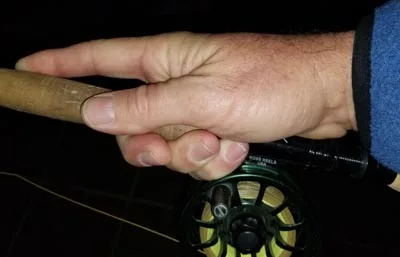
It's much easier to keep the rod tracking straight by using the three-point grip with your index finger laid straight on the cork. Your index finger guides the entire rod straight. It's my preferred grip for most of my fly casting. The grip helps new fly casters develop awareness of where they point the rod tip. There's a natural tendency to guide with the index finger—no one instinctively learns to point with the thumb! It also helps teach pulling the rod through the cast as opposed to forcing rod turnover. Your little finger pulls the rod into the stop, just like the bottom hand does when making Spey casts.
You can find more about the grip in my friend Jason Borger's new book Single-Handed Fly Casting! It's excellent, and I'm sure you'll benefit greatly from reading it. It was great catching up with Gary Borger in Atlanta over the past few days and discussing fly casting with him!
How Fly Rods Affect Tracking for Distance Casters
There are times when a fly rod simply cannot handle the amount of weight and forces that elite distance casters demand. The tip deviates during the unloading phase of the cast, creating a transverse wave into the forward cast and usually throwing a wild curve upon turnover. The solution is to switch to a heavier rod weight! It's all about matching the proper tool for the job at hand. This isn't a concern for the small stream trout fisherman, but it becomes more important for lake fishermen and saltwater anglers who require longer fly casts.