

In the spring of 2014, I published an article entitled "Morphing Loops" about what changing loop shapes tell us about the cast in The Loop. Learn about loop control, morphing, and shapes created in fly casting below. The link to "Morphing Loops" will take you to the entire PDF file. Click the link to read The Loop publication as a PDF from Fly Fishers International. The Loop finally became available to the general public last fall at the International Conclave in Livingston, Montana, after many years. This article is a reproduction of what I compiled for that publication. My friend Leslie Holmes is featured on the cover of that issue, and there are many other great articles, so be sure to check out The Loop.
Morphing Loops & What the Changing Loop Shapes Tell Us About The Cast
A casting instructor can tell much about a student's cast by looking at loop shape alone. Loop shapes—specifically morphing or changing loop shapes like perfect symmetry, dolphin shape, and leading-edge-on-fly-leg—are shapes we see often while teaching and fly casting. Loop shape has interested me for decades. I've analyzed them, performed loop-drop experiments from rooftops, and read both early and current casting literature.
A few years back, Sexyloops (an Internet site) started a discussion on how a loop shape morphs through the cast, which prompted me to look further into the subject. When I did, I found a huge discrepancy among instructors' understanding of loop shapes and how they form. The common belief seemed to be: how you stop the rod influences these various shapes. But the answer is not that simple. If it were, all casters could cast these morphing shapes at will and explain what causes them.
All loops morph throughout the cast, from when the loop first begins to form until it turns over and straightens. My experiments showed that this changing shape is influenced by line speed and rod tip path. The shapes of the loop face are a byproduct of various aerodynamic drag forces. The loop shape at creation will morph during flight and change shape before turnover. The two areas of greatest tension are the unrolling loop face and the rod-leg attachment.
Bruce Richard's Six Step Method
As skilled and serious casting instructors, we must understand that a caster influences the fly-leg of the loop during the loading phase of all casts. The rod-leg part of the loop will mimic what we do after the stop-sequence, or deceleration phase. If we don't understand this, it becomes very difficult to apply Bruce Richard's Six Step Method for diagnosing and improving a cast. I use this knowledge when improvising various fly casts on the water—specifically for casts that use line waves (also called transverse waves) during and/or after the rod loading phase.
Written simply, all fly line reactions are the summation of momentums that the caster imparts during and after the cast. In recent years, a new understanding of loop shapes and morphing has emerged. Caroline Gatti-Bono and Noel Perkins studied the problem using the Richards/Perkins Casting Analyzer. Read Perkins/Gatti-Bono's paper (PDF) from the Journal of Applied Mechanics. It addresses the mathematics and dynamics of various shapes and what loop face shapes imply. (Ed Note: Other articles from that website also address loop shape issues.)
Dolphin Shape Morphing Loops
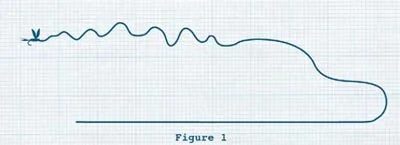
The first loop shape is the dolphin-shaped loop (Figure 1). It has a leading edge that protrudes on the rod-leg in the loop face. It results from low acceleration during the loading phase, an attempt to narrow a loop (another way to say too much SLP), and poor rod-leg and fly-leg tension acting on the loop face. If I were coaching someone to cast Figure 1, I might say, "Throw as narrow and slow as possible."
In April of 2012, I joined other Master Fly Casting Instructors in Atlanta, Georgia to film morphing loop shapes with a high-resolution camera. We wanted to document the changing shapes of loops during a cast and see if we could quickly teach a proficient caster to intentionally throw these morphing shapes. Our test subject was MCI Rex Gudgel. We instructed Rex on the shapes we wanted him to cast. With a few hints on technique, he could cast them in minutes.
Dolphin shapes are easiest to create from snap casts thrown very narrowly with a low acceleration phase. Low acceleration yields lower tension on both fly and rod legs (low Reynolds numbers, for the scientists out there). We often see this shape create "wiggles," especially when the line taper feeds into the loop face toward the end of line turnover. It's an erratic wiggle for the line and leader as they enter the loop face. The fly-leg speeds up into a loop face that is moving too slowly, and aerodynamic drag causes this shape. Since we don't cast in a vacuum, drag components of the atmosphere act on the line to create this chaos at turnover.
Balancing Act of Tension
We see dolphin shapes often in distance casts when they're close to turnover. This aerodynamic phenomenon is a dynamic balancing act between line speed and drag components. When greater mass enters the loop face, the rod-leg section of the loop must increase tension to delay turnover and keep the traveling loop aloft longer. When the mass decreases in the loop face (as it tapers toward the end of the fly line), the rod-leg must decrease tension, causing rapid turnover. This helps explain how various line configurations influence loop shapes. This loop shape has a negative angle of attack (from Gatti-Bono and Perkins' study), which means more downward acceleration than more rounded loops (they refer to the shape as "a falling loop").
Perfect Balance of Symmetry Loop Shapes (Yin/Yang)
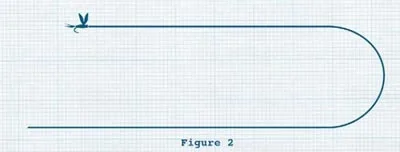
The next loop shape appears with perfect symmetry (Figure 2). It is an efficient cast because the rod-leg and fly-leg are both in balance (Yin/Yang) with proper tension, which eliminates wasted effort.
To achieve this, adjust acceleration to match the rod tip path for the desired distance. This practice produces medium-sized loops with parallel legs. If the loop becomes too wedge-shaped, ease your casting power or throw a larger loop. If you decrease casting power, don't back off so much that the loop takes on a dolphin shape. What produces the best results is around 2 or 3 feet of separation between the rod and fly legs. The most difficult part of this cast is achieving symmetry through turnover while minimizing loop-shape morphing. This shape offers a positive angle of attack for the leading edge, which helps keep the line aloft longer.
Leading Edge of Fly Leg Protrusion Wedge Morphing Loop
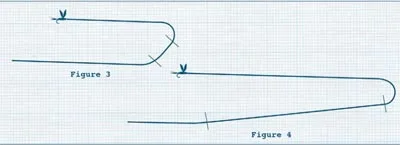
When a cast is thrown with the fly-leg protruding well ahead of the rod-leg of the loop (Figures 3 and 4), efficient tension is achieved on both the fly-leg and the rod-leg. To exhibit this, increase rod-leg tension through hauling and use high acceleration followed by what casting legend Jim Green called the "positive stop"—an abrupt, controlled stop.
These loop shapes are the most likely of all to be a climbing loop when thrown in a vertical cast. According to Perkins/Gatti-Bono's study, this cast claims a positive angle of attack of .924, which translates to a cast that has FOUR times the lift of a circular (perfect symmetry) shaped loop face. This creates a fast traveling loop that is very efficient for distance, wind, or very low casts. The longer the angle from rod-leg to leading-edge on fly-leg protrusion yields the greatest lifting component (referred to in Figure 4).
It typically has the smallest radius as well on the fly-leg protrusion. The shape implies a very tight loop with high line speed and high rod-leg tension. This loop shape has been called a "hairpin" loop. It's what I've witnessed through observation during practices for record distances.
This cast requires fast acceleration, an efficient haul, a positive stop, and the creation of a budding loop large enough at first to handle the greater counter flex. The fly-leg-leading-edge loop is best for long casts and is also the most difficult to teach. This loop shape can be challenging for novice casters, and many extremely good casters have difficulty mastering the tension required. It is also among the most difficult casts to teach students. Learning to throw these morphing loop shapes comes from practice. However, many factors contribute to unintentional loop-shape deviation, including line stiffness, density, and diameter. Factors such as mass distribution, humidity, temperature, fly profile, and others also affect loop shape deviation.
Practice, Practice, & More Practice!
Intentionally creating various loop shapes is a good—even necessary—exercise in loop control for instructors who want to diagnose a student's casts and/or improve their own. Learn to control the various shapes by attempting many of them with the specific objective of achieving loop shape. By varying the acceleration rate with the loop size, you can learn loop morphing techniques quickly. Throw very narrow loops with low acceleration and keep increasing the rate. What changes? By simply exercising this method, loop shapes will become apparent and useful when teaching students. Witnessing the loop morphing shapes will provide all the clues you need to know what the caster did without ever seeing them. Learn about loop control, morphing, and shapes created in fly casting with plenty of practice. Tight Lines! Mac