

These observations on teaching fly casting come from decades of fly fishing schools, guide trips, and casting lessons at Mac Brown Fly Fish in Bryson City, NC. The goal of every lesson is simple: give the student the best possible return on their hard-earned money in the shortest amount of time.
The Most Common Mistake in Fly Casting Instruction
The number one mistake Mac Brown witnesses in fly casting instruction across America is the instructor who plays mechanic — the fault fixer. After a quick assessment of a few foundation strokes, these instructors begin picking faults one by one. Tracking, pause, acceleration, rod stop — all at once, all negative, all counterproductive.
My friend Lee Cummings gave this approach its name: the mechanic. It fits perfectly.
Fault fixer instructors rely on two counterproductive tools: telling the student to “watch me,” and tactile instruction — physically taking the student’s hand and making the cast for them. With new casters tactile instruction leads to a downward spiral every time.
We have all seen it at fly fishing shows. An experienced instructor grips the beginner’s arm, whips the rod back and forth, and the crowd gives the golf clap. Five minutes later that same student picks up a rod and is back to flailing. The only reason it worked is that the instructor made the cast. The student learned nothing.
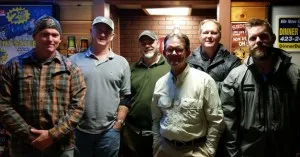
Testers from the study at Lee University on learning modes for fly casting. (L-R) Mac Brown, David Lambert, Eric Cook, Tom Rueping, Guy DeLoach, Brian DeLoach
Instructors Teach Minds — Not Rods
Instructors teach the minds of their students — not inanimate objects like rods and fly lines. To do this effectively the instructor must connect with the student’s past experiences and work from there.
Sports psychology never produces great results through negative reinforcement. When the instructor plays mechanic and piles fault on fault, lesson time is wasted and the student’s confidence erodes. Why keep the focus on negatives?
The better approach when a student has many issues is to bring it back to basics immediately. Teaching the foundation stroke in less than ten minutes using descriptions that connect with the student’s past experience gets results far faster than fault-picking ever will.
Audio Word Pictures and Analogies
Audio word pictures are powerful tools when they connect with the student’s existing experience. Painting a ceiling. Flicking a brush. Throwing a frisbee. Hammering a nail at eye level. These analogies transfer the feel of the casting stroke through familiar motor patterns the student already owns.
When a student has no experience with any of these — use the imagine approach instead. Ask them to imagine the motion. Visualization activates the same neural pathways as physical practice and builds the foundation before the rod ever comes out.
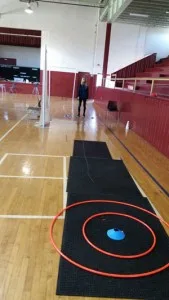
Several of the fly casters from the 15-minute audio learners hit perfect Bull’s Eyes for accuracy
Pantomiming the Fly Casting Stroke
Pantomiming — practicing the casting stroke without a rod — is the fastest method for teaching new casters the foundation stroke. Mac Brown taught both of his sons to cast using pantomime before a rod was ever introduced. The results were immediate.
Pantomiming trains the motor skills of the entire basic cast before the complexity of rod and line is added. Once the correct movement pattern is established the brain and muscles develop consistency — what the layman calls muscle memory. Muscles only perform what the brain tells them to do. Build the right instruction in the brain first and the cast follows naturally.
The goal of every lesson is to build on positives — giving the student a foundation they can self-correct on any water for the rest of their life. Visual aids combined with audio feedback is the fastest method for getting this foundation across.
When Tactile Instruction Works
Tactile instruction — physically guiding the student’s movement — has one legitimate application: advanced casters learning a new presentation cast. A student who has already made thousands of basic casts and wants to learn a curve cast or a pile cast can benefit from the combination of audio feedback, a visual demo, and tactile guidance in sequence.
With new casters tactile instruction is always counterproductive. With advanced casters it can accelerate learning of specific skills when used carefully and briefly.