

2026 competition result: Michael Bradley won the individual title at the 2026 FIPS-Mouche World Fly Fishing Championship (45th edition), September 13–18, 2026, held across venues in Idaho, Montana, and Wyoming. He finished with 20 placing points and never placed worse than seventh in any session. He is the first American to win the individual world title since the championship began in 1981. He was a member of the Team USA squad that won the program's first-ever Senior World Fly Fishing Championship team gold in 2026. Read the USAngling release.
Myths on Rods and Tippet for Fighting Fish
Myths about rods and tippets for fighting fish with a fly rod have been misunderstood and debated for a long time. By 2016, I had spent the better part of 34 years teaching, instructing, and guiding fly fishing. There are numerous opinions on absolutely every aspect of our sport. This 2016 article addresses some of the most common issues.
This first piece addresses a common myth: that light rods and tippet kill fish. My friend Michael Bradley sent me a Facebook thread about this topic before this article's publication in 2016. As you all know, if it's on the internet, it must be true! myths rods tippet fighting fish
I thought about how people react to things they're typing about behind their keyboards—often getting out of control—rather than engaging with the actual subject matter of the thread. Instantly, folks begin attacking with elitist comments. Everyone is at different levels of understanding for virtually every aspect of the sport. Use whatever equipment makes you happy, but understanding how your equipment performs is what matters most!
Trout Fishing Is a Prideful Sport
Fly fishing has plenty of prideful people in general, as do all sports. Here's a classic example from April 2015. I'll use my friend Jon Dietz, who was down here training for Team USA Youth. He has a very strong work ethic and constantly strives to improve his skills on the water. He's fished at the highest level of Team USA Youth competition in the World Championships.
I dropped him out on the most crowded section of the river with close to 50 anglers fishing several large pools. I left him there for about six hours while I did a float trip. When I got back, the other anglers had retreated far from him because he was catching fish consistently—almost every couple of minutes all day long! Our goal that day was focused on wet fly fishing. Not one person asked him what he was doing or showed any interest in learning.
The majority of anglers are a prideful bunch who would rather leave than learn something new. If you guide on the water, you know the type—let's call him Dick. Dick is plagued with tailing loop knots and casts his line into trees every few minutes. He sits down and spends 30 minutes tying a clinch knot. The magic flies the shop sold him are somewhere in the trees. The sport is full of nice guys like Dick!
Is Fly Fishing Headed in a Positive Direction?
This raises some interesting questions for our industry: Do we really want more of these types of people on the water? I read a great piece in January 2016 called "The Three-Knot Fisherman," which explores many thoughts from the industry here in America.
How could folks spend thousands of dollars on the finest equipment money can buy and still cast like a beginner decades later? For many, it's just one trip a year to some famous destination for the picture. How do we get an entire country to break away from mediocrity and really commit to improving instead of becoming like Dick? In part, the media is to blame for not covering more educational content about the sport. Educational content will increasingly come from blogs by people who can back it up, like my friend Devin Olsen's "Tactical Fly Fisherman." He also includes amazing photography to complement the content. Typically, the media pushes destinations, new flies, new rods, new waders—everything except advice that would help you solve problems on the stream. So much fluff with little substance has become the norm here in the States for a very long time! In other words, skill set trumps gear most of the time.
Education Is Key to Growing Trout Fishing
By 2016, I had been very fortunate to spend 34 years teaching casting, fly tying, and fishing with some of the finest people around the globe. I use the word fortunate because I've learned about their styles of casting, tying, and fishing. Learning from all of them has enriched me greatly both on and off the stream. I am and always will be a student of casting, tying, and fishing.
Long fly rods of 10'6", 11', 11'6", and 12' in the three-weight range have been very popular in and around Western North Carolina. I pushed hard for G. Loomis to make these back in 1990 for my programs and schools. Steve Rajeff, a rod designer at G. Loomis and casting expert, provided me with some long prototype rods at 10'6" in length (early 90s) that were a perfect match for my style of fly fishing. The company didn't think it was economically viable to commercially produce long three-weight rods.
I built four other rods (10'6" to 12' footers)—all three-weight—over the next few years and fished them all over the globe for trout. My friend Tim Rajeff, a rod designer at Rajeff Sports and fly casting expert, told me in 2015 that my region of the country has the majority of his Shadow 2 fly rods. In 2016, I had two young boys, so I had invested in at least a dozen Shadow 2 rods for the years ahead.
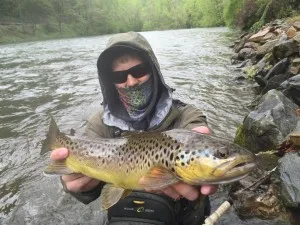
Jon Dietz with a nice Nantahala Brown Trout
My friends Josh Stephens and Chris Lee both brought competitive fly fishing to Western North Carolina. Both attended the semester-long fly fishing program at WCU during the mid-1990s. When Josh Stephens moved back here from Colorado around 2007, he was already a member of Team USA, which created quite a buzz in this region of the country. I know this opens a whole discussion—some folks either love or hate comp-style angling—so we'll just say it's controversial to many.
The drive for efficiency should be on most folks' radar if they're serious about growing their skills. Early discussions with Josh about competitive angling were exciting to me because it reinforced efficiency, which is how I've always approached instructing in fly fishing! myths rods tippet fighting fish
Bryson City has hosted Team USA National and multiple regional competitions, Team USA Youth, Team NC, and many years of the largest paid purse in American fly fishing out of Cherokee, NC with the Rumble in the Rhododendron. The buzz created by all of this activity taking place right here in Bryson City (population 1,400) has been most certainly exciting.
Competition Angling in Bryson City, NC
In general, we use the largest tippet we can effectively get away with for the situation at hand. South Island of New Zealand is one of my favorite places on the planet for trout. Throwing big Royal Wulff dries (#10) using 0x tippet and a three-weight rod for really large trout was common during the late 1980s. Those trout were consistently landed in under a couple of minutes.
When we filmed Fly Fishing Show TV shows, some wagers were made with camera crew members who thought the three-weight rod would stress the trout. The bet probably wouldn't have happened if Speights (a famous Kiwi beverage) hadn't been involved. The first dozen wild sea-run browns—all very heavy fish—were all in the net in under two minutes! So, to the point: rods don't play fish; they're just a tool. People play fish by understanding where they exert the most pressure on the fish.
Which rod weight can exert greater force on a really large fish—a #3 or a #8? (assuming the same lines). I often ask these questions to find out where someone is along their fly fishing journey. There are many answers, so for this example, I'd be looking to discuss various rod positions. The answer "it depends" would be spot on. Can they both exert equal force to the fish? Absolutely, if both rods are pointing at the fish and the angler pulls the line.
Understanding Rod Angles & Pressure
But are they equal if the fish (load) is 90 degrees to the rod angle? The eight-weight could exert greater force on the fish at the 90-degree position. The 90-degree angle is best executed on either side because the torso and lats exert the pressure. A big muscle group does the work. For all practical purposes in trout fishing, does it matter? Probably not in my opinion because, as I mentioned earlier, the angler controls the landing of fish. myths rods tippet fighting fish
The comfort of using a #7 or #8 on the lakes makes a long cast in the wind easier. Fly casting big flies on a 350-grain head (T-18) works much better on a #7 or #8 weight rod. Really, it comes down to the tactic used on the stream, average casting distance, and conditions (wind, tight or open surroundings) for why you'd choose a bigger weight rod.
Choosing your six-weight to fish small flies on a tailwater or spring creek is like planting your garden kale seeds with a backhoe! Many anglers believe a #3 weight rod has limitations for landing huge trout. This isn't the case once you understand rod pressure angles.
Correct Fly Rods for Light Tippets
Take this one step further: the tippet is only 6x. We'll compare the #3 (10'6") and #8 (9') weight rods using small tippet. Which rod increases your chances of quickly landing the fish? Can the rod help prevent lactic acid buildup, or is it mainly angler technique? Could it be both? My chances improve greatly using a longer, more supple lever—the #3—over a stiff #8 that feels like a broomstick. The reason we often fish lighter tippet is to sink a small fly quicker in certain situations. If I can get away with using heavy nymphs in big water, I'll use heavier tippet because it lands fish quickly, whether small or large.
Many claim that competition rods have a secret rod butt design. Any longer rod usually has a stiffer rod butt to support the added length. A longer rod makes distant presentations easier by elevating the rod higher. Fly casting (single-handed Spey) is easier because of the longer lever. Setting the hook and playing fish with a longer rod enhances your productivity for landing fish quicker. Think of the suppleness (bend) in the rod as insurance that protects smaller tippets.
Play Fish with Side Pressure
We've all seen anglers hold the rod straight up with little pressure exerted on the fish. The Orvis logo—showing an angler holding the rod straight up—might jog some folks' memory. There are times to lift the line off the water, but they're rare. These anglers are usually the ones responsible for playing fish too long and causing lactic stress.
I hope "Myths on Rods and Tippet for Fighting Fish" has influenced your gear selection. There's another great piece on hooksets that's closely related to this article. It's not an equipment problem nearly as much as an experience problem—knowing where, when, and how much pressure to exert! myths rods tippet fighting fish