Instruct & Teach Fly Casting
Observations on how to instruct and teach fly casting lessons have been a passion of mine for many decades. A group of four Master Fly Casting Instructors and two Certified Instructors met at the campus of Lee University to conduct a modality study on teaching fly casting. Eric Cook, Tom Rueping, David Lambert, Guy DeLoach, Mac Brown, and Brian DeLoach served as instructors for the study. The full article is in The Loop Fall 2016 edition. The Loop is a publication by Fly Fishers International.
Over 60 college-aged students participated in the study to evaluate effective methods of teaching fly casting. All students established a baseline of casting at targets before receiving instruction using only one of five methods. The methods included reading literature (text), experienced instructor hands-on approach (tactile), verbal instruction (auditory), visual instruction (visual aids only), and a combination of audio and visual instruction.
The baseline assessment for all students included loop formation, acceleration, timing, rod arc, and three attempts at accuracy targets. All participants tested again after receiving instruction using only one of the methods listed below.
Text Group of New Fly Casters
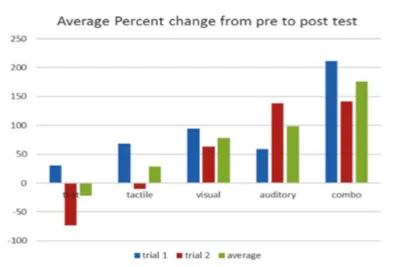
The groups that read only a few pages on fly casting actually performed much worse than the group with no instruction at all! These results are shown in the graph at the bottom of the page. This irony aligns perfectly with the old saying "you can't learn fly casting from a book." The "feel" aspect and experiential learning about the results of your actions on the fly line are essential to learning how to fly cast. Books can provide clues for a deeper understanding of how things fit together in your fly casting journey.
Tactile Group of New Fly Casters
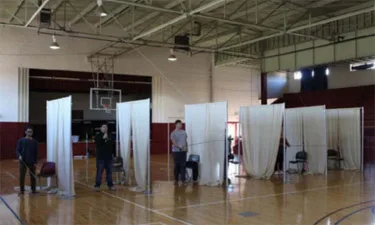
We have all known instructors who believe a "hands-on" approach works for them. These are probably the same instructors who tell students "let the rod do the work." The tactile group also performed worse after "tactile" instruction. The curtains in the picture above created a buffer for all students. An interesting observation was the negative body language of the students. Many of them were smiling until instructors literally forced their hands through the stroke. For new students, this is almost always a counterproductive teaching method.
Auditory Group of Beginner Fly Casters
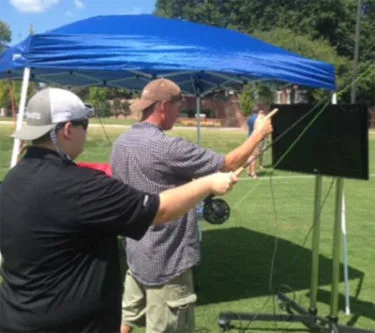
As a fly casting instructor, it really helps to learn a bit about your group—such as what hobbies or other interests do they have? I instructed the auditory groups during both testing sessions. As an instructor, you have to connect with folks from all walks of life. Three of my six students were texting on their cell phones before I started, which became my opening for auditory teaching. Mel Kreiger helped write about pantomime methods for teaching. During the ten-minute instruction period, I had them pantomime the fly casting motion using only their hand, using the action of answering a cell phone as a reference. Three of the students scored perfectly on target accuracy with only 10 minutes of pantomime instruction! My friend Christopher Rownes has some classic Mel notes on teaching on his website.
Visual Group of Beginner Fly Casters
The visual group was exposed only to watching a video or an experienced instructor perform casts, then tried to mimic what they witnessed. This group received no audio feedback. The results were marginal at best, because without feedback, there's no real need for full-time instructors! These days, many people think they will learn complicated processes from a YouTube video. However, there will always be strong demand for skilled instructors who can diagnose faults and provide direct feedback.
Combo Group of Audio and Visual Fly Casting Students
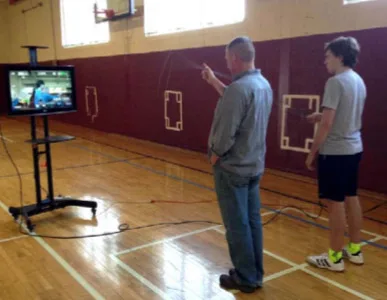
The combo groups showed great improvement because direct feedback combined with visual aids produces results! One of the best two teaching aids used during the entire study was the combination of a mirror and video monitor with an experienced instructor. Results were instantaneous because of the added visual perspective! I had used video for lessons over the past decade, and this study solidified the concept for me because of the results at Lee University. Direct audio feedback for diagnosing casting faults can be equally effective when witnessed on video as when standing next to the student.
Results of Modality Study for Teaching Fly Casting
The graph demonstrates the "before and after instruction" results. The blue bars represent fly casting performance before any instruction, while the red bars represent performance after 10 minutes of instruction. It is my sincere hope that something in this study inspires you to refine your methods of connecting with students to foster higher-level learning.
Teaching kinesthetic motor skills offers a unique opportunity for instructors to be effective communicators. These results are applicable to many other sports such as golf and tennis because all kinesthetic motor skills respond to specific modality methods of teaching that can be most influential for learning. Observations on how to instruct and teach fly casting lessons provide a passionate journey for both teachers and students.