

Fly Rod Actions
Understanding fly rod actions, modulus, rod feel, and dampening from the studies at Western Carolina University in 1996 helps you make informed decisions about your gear. It's best to avoid rods with extreme actions unless you're a highly skilled caster with a specific need. For example, distance casting may benefit from faster-action rods due to their ability to create a smaller loop. A broom handle provides one extreme example of fast action, while a green switch from a willow tree represents the opposite extreme—a very slow action that would be too soft for controlling the loop at distance. Try roll casting with all three types of rod actions and test for yourself which rods require the least amount of effort.
Whenever a group of anglers gathers, the hot topic inevitably turns to comparing one manufacturer's rod to another. This is especially evident on various internet forums, at fly shops, conclaves, and on the stream. There is no single ultimate rod action designed to please every caster, as evidenced by the many different actions produced by popular manufacturers today. The rod study did find that certain attributes are necessary to satisfy experienced casters. Rods that received the highest ratings in the blind study felt good to cast at all distances, while those with lower ratings lost the "feel aspect" because they were uncomfortable to cast.

Modulus
Modulus is a material's resistance to elastic deformation under load. In fly casting, the bend under load is referred to as stiffness. The evolution of rods includes wood, cane, steel, glass, and graphite. The most noticeable changes include lighter rods that maintain similar stiffness due to improvements in section modulus. The stiffness-to-mass ratio has increased with each technological advancement in fly rod evolution, and the reduction in weight typically increases the rod's frequency.
Rod diameter often decreases with each technological improvement as modulus increases. For example, graphite-four rods typically have a smaller outside diameter than graphite-three rods. In general, a larger rod diameter produces a stiffer rod, as does a shorter rod when using the same material for construction.
Fly Rod Feel
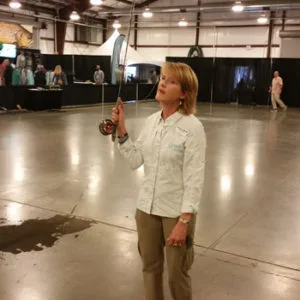
You'll make the best decision when choosing a new rod by first evaluating all the data together (most importantly, the price you can afford) and then testing the rods yourself. The "feeling" aspect encompasses many attributes that influence your decision, often beyond what you can put into words. Feel is the most important overall aspect of casting because it includes weight, balance (distribution of weight), frequency, continuity (how smoothly the rod translates its energy), dampening, and stiffness. While all these terms describe rod attributes and many are interdependent, the survey group felt that the terms "fast," "medium," and "slow" action can be misleading as singular definitions for describing these qualities.
The casters were able to cast all the rods at varying distances because they could compensate for design flaws. They would not, however, purchase a rod when the "feel aspect" was compromised. Every rod exhibits its own unique performance characteristics for casting. There are slight advantages and disadvantages for each action in different angling scenarios. Choosing the proper rod will provide you with many years of enjoyment for casting and landing fish. For example, the limberness of a long #3-weight rod will protect fine tippets more easily than a "fast-action" #6-weight rod.
Dampening
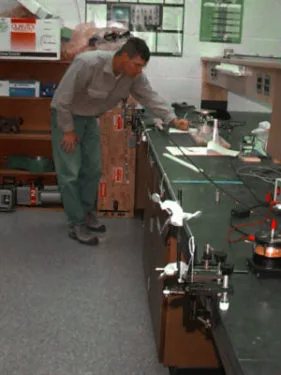
All rods that rated high in the study also dampened most quickly. The dampening test is important because a lower number (measured in seconds) is better. This test is reproduced by mounting the rod butt on a horizontal surface and pulling the tip down 23.22 inches. The tip is then released, and the movements are timed until it falls to within .393 inch. The test accounts for many factors from other tests combined, including stiffness, weight, taper, frequency, and others.
Dampening data may also indicate continuity problems when compared with frequency and deflection tests. For example, a lower dampening figure indicates a well-constructed rod taper. A low deflection test percentage implies a fast-action rod (around 20%), and a higher frequency implies a faster-action rod. But what if frequency and deflection data both suggest a fast-action rod, while dampening data implies a slower action (takes longer to recover)? There may not be enough support near the butt to support the tip properly. This example may indicate a continuity problem that you can identify even before casting the rod, as explained below.
Fly Rod Taper
An easy way to understand dampening is to observe how a tree grows. There is a consistent taper from the tree trunk to the treetop, and rods—as well as many other structures—are designed the same way. The butt of the rod must be able to support the tip when casting, and the power in a rod comes from the butt. Fast-action rods exhibit greater reserve power, which is important for casting greater distances. The taper of the rod is what makes every rod unique. Generally, a fast taper results in a fast action (stiff, high frequency, increased dampening). Medium-action rods have a more consistent taper similar to the tree analogy above, offering greater flexibility for most trout fishing scenarios.
Spline Testing
The spline was also observed when the entire rod was balanced on a knife edge. The rod would deflect toward its weakest side, similar to a trapeze artist walking with a long pole that sags on each end. Balance the rod on a credit card resting on a flat surface and observe the direction the eyelets point. Perform this test simultaneously with the balance point test mentioned earlier. The test revealed that most eyelets do not point straight up or down along the spine, but instead average 33 degrees from the true spine.
Only 34% of the rods tested had eyelets splined exactly up or down. This finding was also compared back to the dampening test. Lab records noted that rods tracking straight up and down during the dampening test were the same rods that appeared splined correctly, while non-splined rods tracked in an elliptical pattern upon release.