

Fly Rod Balance Point
Understanding fly rod balance, swing weight, deflection, and frequency are a few of the significant factors found from the WCU fly rod study. One of the first impressions you'll feel when picking up a rod is its balance. The balance figures included in the data are derived by dividing the balance point of the rod by its total length and expressing it as a percentage. You can compare balance points quickly when shopping for a rod by balancing it on a flat object, such as a credit card or knife.
Measure from the butt of the rod to the balance point to make a comparison. The lower the percentage, the more comfortable the rod typically feels when holding it. This depends on the rod's overall weight. The rods that received the highest ratings from the group were typically less than twenty percent.
Tip-Top Weight
The weight of the tip is important for conserving energy when casting. As an angler, you constantly hold the rod up throughout the day. For example, assume the tip-top weight differs by .25 of an ounce. Not only does this affect muscle fatigue in your shoulder—since the rod is a nine-foot lever—but it also adds up quickly when performing casts. This could easily translate into several hundred pounds of additional work during an all-day casting outing. This directly influences the rod's balance and overall weight. The casters favored rods with the lightest tip-top weight, typically less than .5 of an ounce.
Overall Weight
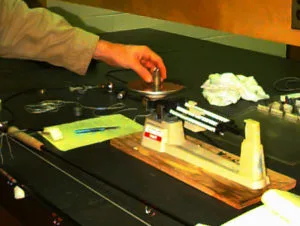
The rod's overall weight is noticeable when you pick it up. The balance and weight data can be reproduced by most individuals through feel alone when comparing one rod to another with great accuracy. This is done by gripping each rod and judging its weight and balance. The human element for these types of tests is highly accurate, even for novices. The rod's weight is sometimes labeled on the rod by the manufacturer. However, many rods were off in claimed weight versus actual weight by more than the entire tip-top section of a two-piece rod—27% of the actual weight! You can verify this by using an accurate scale when comparing rods.
Swing Weight of Fly Rods
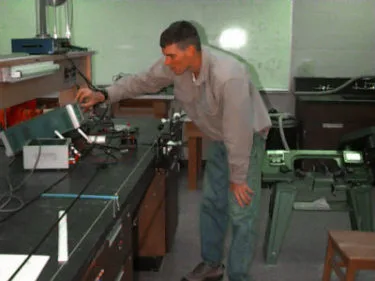
Swing weight refers to the overall weight displacement and balance point relative to an imaginary fulcrum away from the fly rod's grip. It's the feeling of the rod in motion when rotated. To a physicist, swing weight is called "moment of inertia." Think of swing weight as the rod's resistance to being swung in a circle. Swing weight is huge for fly casting—it directly affects the "comfort" and "feel" of a rod's action. Rods with poor swing weight are rarely sought after by beginners through advanced anglers because they're simply uncomfortable to cast.
Deflection Measurements for Fly Rods
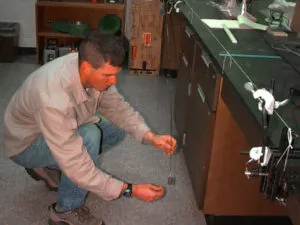
The deflection test provides data on the stiffness of the fly rod. The rod's butt is mounted in a perfectly horizontal position for measurements. A rod butt vise is aligned with a string and adjusted with a laser. Measurements were taken at the midpoint of the rod (54 inches), three-quarters of the rod (81 inches), and the tip of the rod (108 inches) when the rod was deflected with a weight of 2.48 ounces. Each reading was divided by the perspective length to that point to obtain a deflection percentage. For example, if the rod deflects 22 inches at the tip, divided by the length of 108 inches, this yields 20.37%. This provides enough general information about rod deflection.
You can perform a couple of different tests when shopping for rods. The first test is to place the rod tips on the ground while holding the butt end at your eye level. When you apply equal pressure to both rods, you'll begin to see differences in how they deflect. In general, faster-action rods deflect less. This provides greater hooking power and hook sets but loses some of the potential energy within the rod, meaning you must exert greater force when roll casting. Medium-action rods, by contrast, yield greater deflection, which provides increased control over casting the line and landing trout.
Common Cents System for Measuring Deflection
William Hanneman introduced this method for discussing fly rod deflection around 2001. He coined the term "Common Cents System" for measuring fly rod actions. It's a good starting point for telling consumers more information about overall fly rod action once you understand what deflection ratios mean. However, our results from the WCU study did not find deflection to be as significant as other factors. Quick dampening, overall weight, balance, and swing weight were most significant for rod performance and feel.
One problem with simple deflection calculations is that a low-quality rod can match a high-end rod on deflection alone, yet still be total junk. For example, what if the low-end rod takes a long time to dampen because the tip end is heavy? This affects "rod feel" because you're holding a lever with weight distributed too far from your grip. It affects rod balance, dampening, and most importantly, the swing weight. Simply looking at a tapered cantilevered beam with deflection data omits many important attributes that we found significant during the rod study.

Continuity
Continuity describes the transfer of energy from the caster through the rod. Sometimes a rod has a soft spot within it—usually somewhere toward the tip—due to poor rod design. Experienced casters quickly reject these rods because they're uncomfortable to cast. The rod may hinge toward the completion of the cast, which feels as if the rod is trying to jump out of your hand.
Sometimes the rod hinges toward the butt, which may be uncomfortable because the rod recovers with increased recoil, moving your hand up and down. This is typical of poorly designed tapers for slower rod actions. These continuity problems are difficult to identify without actually casting the rod. As a rule of thumb, if the rod doesn't feel comfortable at the completion of the cast, keep searching. There must be unity between the entire system—the caster, rod, line, and fly—when fly casting. Don't confuse continuity problems with a lack of adjustments on your part. It's your ability as a caster to adjust the timing and application of force to the rod when casting different rods.
Frequency
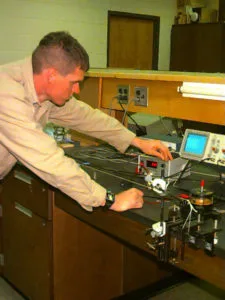
The frequency test provides accurate figures for the fundamental frequency. Frequency is the condition of occurring at regular intervals given varying inputs of force. Data were also collected for the 2nd and 3rd harmonics of rod frequency. The data shows the numbers for the frequency that activates the rod, measured in Hertz. Fly rods exhibit many frequencies when actually casting. All casters have varying physical features that enable them to exert a certain range of force. For example, a young child may not generate enough force to load a rod. For this reason, no single rod design is suitable for all casters. The higher the frequency number in the data may imply a faster action, depending on the deflection and dampening characteristics explained below.
The wig-wag test involves shaking the rod side to side with different tempos. Experienced casters tend to have accurate first impressions of a rod's frequency. For example, several casters shook rods while blindfolded and accurately described the actions as fast, medium, or slow. They also picked the top ten rods from the entire survey based solely on feel.