

Understanding loop plane has been largely overlooked since the inception of fly casting. Tradition has perpetuated the ideology that rod plane always matches loop plane. For example, when casting with a perfect vertical rod plane, the loop plane should be directly above the rod tip—or should it? What if you make the vertical stroke with a curved rod path, like a crescent moon shape? You can get a refresher on these terms at the fly casting glossary.
Evolution in fly casting has progressed slowly partly because many hold fast to traditional concepts. Your intent as a caster—what layout you desire—will greatly depend on your creativity in piloting the rod.
A straight rod tip path is excellent for accuracy and distance fly casting. It has been taught in videos, books, and mantras by the world's largest fly casting organizations. The problem is that most instruction left out the intent or objective for the student. Understanding loop plane will increase your overall control for performing fishing casts!
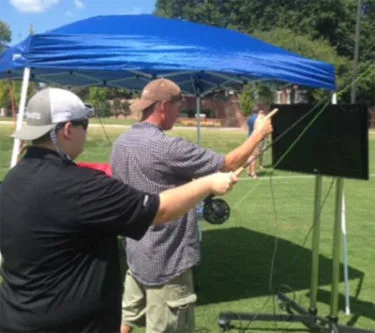
Pantomime the Rod Tip Path with Student
Rod Plane and Loop Plane Are Not Dependent on One Another
To control the loop plane all around the rod tip, you must pilot the rod in a curved path. In fact, a curved path is the only rod path that enables you to change the loop plane. Let that sink in for a moment. A straight rod tip path will produce a loop plane that matches the rod tip path, assuming proper application of power. But what about the other 359 degrees available for altering the loop plane?
There are many examples of where we use this for presenting curve casts while fishing. Why should you explore it? Because as obstacles change on the stream, you'll be forced to use multiple rod planes while fishing. Just as obstacles change, so will currents demand presentations that match varying water conditions. Understanding loop plane will enable you to execute many other fishing casts on the stream!
Deviating Loop Plane Exercise
A great exercise for casting varying loop planes is to perform the fly cast using a horizontal rod plane. If you use a straight rod tip path, the loop is created directly out and away from you. Now, using a slightly curved crescent moon shape that travels upward during the application of power, can you create a loop plane that's directly vertical? Absolutely—because you created a curved path with your rod hand!
Now create a loop plane that travels inverted, with the fly leg traveling on the bottom of the unrolling loop. Continue using the horizontal rod plane for this exercise. Guide your rod hand as if it were following a huge shallow salad bowl. This downward rod path will produce a nice loop that many call an upside-down unrolling loop.
You can throw the loop plane anywhere around the rod tip path if you deviate from straight. The benefit is greatly improved presentation on the water. Remember that all fly casts are either straight or curved! You'll make a huge jump in fishing cast competency once you control your loop planes.
Teaching Rod Tip Paths
One of my close fly casting peers uses an expression for lessons that paints a vivid image of various paths. Keep in mind these are just like cardinal points on a compass, because there are many degrees in the round world of fly casting.
Scribe the rod tip path straight through the moon, which keeps the traditional folks happy for starters. Greater control of loop planes happens when your rod path travels over and under the moon. Also try outside and inside the moon. When my kids were very small, this was one of their favorite exercises for warming up before casting practice.