Fly Fishing Terms & Definitions

Technique — March 2, 2018 — 226 terms — Updated October 12, 2026

Fly Fishing Terms & Definitions

The complete fly fishing glossary — 200+ fly fishing terms defined for beginners and experienced anglers alike, covering equipment, casting, entomology, knots, tactics, and reading water. Written by Mac Brown, FFI Master Casting Instructor and author of Casting Angles, based in Bryson City, NC. From tippet to tailwater, drag-free drift to double haul — every term you need to understand the language of fly fishing.

Back to Blog
Fly Fishing Terms & Definitions

Fly Fishing Terms, Glossary, and Definitions

The intent of this page is to provide some of the more common terms used in fly fishing for those on the journey of learning this magnificent sport! It may seem overwhelming to newbies at first, but these terms fall into place quickly once your curiosity takes over. Fly fishing terms, glossary, and definitions are unique to the sport and are often neglected by other dictionaries.

It is our sincere hope that some of these terms will bring you a complete understanding of what the sport has to offer! Fly fishing is fundamentally about waving a fly line with a flexible stick to propel a hook dressed with fur and feathers in hopes of deceiving a fish. The sport has been around for a very long time, and the observations made on every outing help enrich and feed this fascination.

I am sure that this list will have many additions over the coming years. The motivation for creating it came from my latest book, which I am finishing, called "The Fly Fishers Triad." It will provide many insights into tactics, techniques, and tactical casting. Fly fishing terms, glossary, and definitions come together quickly once folks are engaged in the facets the sport provides. Tight lines, Mac

A

Adipose fin
The adipose fin is the small fin on the back of a fish behind the dorsal fin and in front of the caudal fin.
Albright knot
An Albright knot joins two lines of very different diameters or materials, such as backing to fly line or a heavy shock tippet to a lighter class tippet.
Anadromous fish
Anadromous fish are born in freshwater, migrate to saltwater to grow, and return to freshwater to spawn — such as salmon and steelhead.
Anti-reverse fly reel
Anti-reverse is a feature of fly reels where the spool handle does not turn as the line is pulled out from the reel — generally used in saltwater for big or fast species.
Arbor
The arbor is the center part of a fly reel onto which backing is wound. Fly reels come in standard arbor, mid-arbor, and large arbor configurations.
Arbor knot
An arbor knot is a knot used for tying backing to the arbor of the fly reel.
Attractor fly pattern
An attractor is a style of fly effective in eliciting strikes with hot colors such as fluorescent orange, pink, and chartreuse, and mylar in silver, gold, and clear pearlescent — yet has few characteristics of a natural food item.

B

Back cast
The back cast is the half of the casting stroke that sends the line behind the angler. A good back cast unrolls fully and straight before the forward cast begins, which sets up an accurate, efficient forward cast.
Backing
Backing is a braided line that connects the reel spool to the fly line. It serves two functions — filling out the spool so the angler makes fewer revolutions to wind the line back onto the reel, and providing additional length beyond the fly line.
Baetis
Baetis is a genus of small mayflies, commonly called blue-winged olives or BWOs, typically sizes 16 to 24. They hatch in cool weather, often on overcast or drizzly days in spring and fall, and are one of the most important hatches on Smoky Mountain tailwaters and freestones.
Barb on a hook
The barb is the backward-facing projection cut into a hook.
Barbless hook
Barbless hooks are either manufactured without a barb or the barb is squeezed down using hemostats or pliers or filed down. The use of barbless hooks makes it easy to remove a hook and reduces damage to the fish. Barbless hooks are superior for penetration and hook-ups.
Barrel knot
A barrel knot is another name for the blood knot, used to join two pieces of monofilament or fluorocarbon of similar diameter when building leaders.
Beadhead fly
A beadhead fly uses a bead immediately behind the hook eye — usually made of brass, lead, or tungsten — to assist in sinking the fly.
Belly boat or float tube
A belly boat is a one-person craft with a seat across the bottom on which the angler sits with feet in the water — using scuba fins to move around. This type of fishing boat is very popular with warm water fly fishers and those who fish high mountain lakes. Also called a kick boat.
Belly of a fly line
The belly is the middle portion of a tapered fly line — the thicker central section between the front and rear tapers.
Bimini twist knot
The Bimini twist is a knot used in saltwater fly fishing that has a loop and a double line section — making it especially strong.
Blood knot
A blood knot is a widely used knot for tying two pieces of monofilament with similar diameters together. Also called a barrel knot.
Bob fly
The bob fly is the fly closest to the fly line when fishing multiple fly rigs — the top dropper of the leader.
Bobbin in fly tying
The bobbin is the fly tying tool that holds the tying thread.
Bodkin in fly tying
A bodkin is a tool with a needle and a handle — easily made from a piece of wood or stag and a needle. It is used in fly tying to deposit lacquer on a fly or pick out materials.
Braided loop connector
The braided loop connector works like the so-called Chinese finger torture for joining fly lines — it is a way of putting an in-line loop at the end of your fly line.
Break-off
A break-off occurs when a fish snaps the line — usually due to the angler applying too much pressure. It can also result from an undersized tippet, poor quality tippet material, or a poorly tied knot.
Breaking strength
Breaking strength is the amount of force, in pounds, a line or tippet withstands before it breaks. Knots reduce breaking strength, which is why knot choice and careful tying matter as much as the tippet itself.
Bucktail fly pattern
A bucktail is a streamer fly tied to imitate a fish. The fly usually features a long segment of hair from a deer's tail laid back from the eye to the bend of the hook.
Butt section
The butt section refers to two things — the thicker end of a tapered leader that is tied to the fly line, and the last section of a rod at the cork handle.

C

Caddis
Caddis are one of the three most important aquatic insects imitated by fly fishers — the other two being mayflies and midges. Caddis are found worldwide in all freshwater habitats. While at rest the adult has wings folded in a tent shape down the back. The pupa is the most important aquatic state — it is the emerging stage.
Cast of flies
The cast of flies refers to the rigging and placement of the droppers and point fly on the leader — common terminology in the United Kingdom. A cast of flies would include a bob fly, dropper, and point fly.
Casting arc
Casting arc refers to the angular starting and stopping points of the fly rod when making a cast.
Catadromous fish
Catadromous describes fish that migrate from freshwater to the sea for spawning.
Catch and release
Catch and release is a conservation technique in fly fishing — the recycling of fish for all anglers to enjoy the sport. Fish are landed quickly and kept in the water to be released back into the wild.
Caudal fin on a fish
The caudal fin is a large tail fin on the very back of a fish that provides thrust when swimming.
CDC in fly tying
CDC is the fluffy webbing from the preen gland of usually a mallard duck that has excellent floating characteristics.
Char
Char are a group of fish in the salmon family that includes brook trout, lake trout, Dolly Varden, and Arctic char. The Southern Appalachian brook trout, the only trout native to the Smoky Mountains, is a char, not a true trout.
Chironomid
Chironomid is the scientific name for members of the Diptera family of insects commonly known as midges. In the pupae stage they typically appear as small aquatic worms. They occur throughout the year but are most common in the winter months for the fly angler.
Click drag or click and pawl reel
A click drag is a mechanical system on a fly reel used to slow down or resist the pulling efforts of a fish. The audible noise of clicks is beneficial for knowing when a large fish slows down during the fight.
Clinch knot
The clinch knot is the most common knot for attaching a hook or any other ring to the line.
Comparadun fly pattern
A Comparadun is a hackleless dry fly with a fan-shaped deer hair wing and split tails. It rides low in the film and gives a realistic silhouette for selective trout feeding on mayfly duns.
Cone head fly
A cone head fly is the same as a beadhead but the bead is cone-shaped.
Current seam
A current seam is formed where differing high and low pressures of water flows meet. Water travels in all directions on a river of fast and slow currents depending on the bottom structure and general flow patterns. Water hydrology is always dynamic and changing depending on water levels.
Curve cast
A curve cast is a casting technique that allows the cast to land in an abrupt curve. Many fishing scenarios use curves for enhancing the presentation.

D

Damselfly
A damselfly is an important still-water aquatic insect most commonly imitated in the nymphal form. Damselfly hatches are usually abundant in the summer months. The adult looks similar to a dragonfly but smaller and folds its wings along its back when at rest.
Dapping
Dapping is a relatively ancient technique of presenting a fly on the surface of the water where the fly is bounced up and down to entice a strike.
Dead drift
Dead drift is a perfect float in which the fly moves at the same pace as the current — used in both dry fly and nymph fishing.
Disc drag fly reel
A disc drag is a mechanical system on more expensive fly reels designed to efficiently slow and tire a fish taking the line. Resistance is created between discs that apply pressure as the line is pulled from the reel. The disc drag is smoother and less likely to create a sudden stopping resistance that will break the line compared to a click drag.
Dorsal fin on a fish
The dorsal fin is a large fin on the back of a fish toward the head.
Dory
A dory is a fishing boat that has been around for centuries with simple lines and easy to build construction — usually 16-24 feet in length with high sides, an arched bottom, and sharp bows. Generally rowed using oars and oarlocks.
Double haul
The double haul is a casting technique where the fly fisher tugs and gives back the line in both directions. It creates great line speed and reduces fatigue when making long casts, casting low to the water, or specialty curve casts.
Double taper fly line
The double taper is a standard fly line design in which both ends of the line are tapered while the greater portion or belly of the line is level. It is an excellent line for roll casting and elite distance casts because there is greater overall line weight than a weight forward line.
Drag
Drag has two meanings in fly fishing. First, an unnatural motion of the fly caused by the effect of the current on the line and leader — usually detrimental though at times useful such as imitating the actions of the adult caddis. Second, resistance applied to the reel spool to prevent it from turning faster than the line leaving the spool — used in playing larger fish.
Drag-free drift
Drag-free drift is accomplished when you minimize the effect of the current flow on the fly. Trout are more likely to take food moving at the same speed as naturals being carried by the current and may be spooked by flies moving too fast or too slow.
Dragonfly
Dragonflies are large and ferocious insects in the underwater world — excellent insectivores found in rivers, streams, and lakes. The large sizes of dragonflies make them an important food source for fish.
Drift
Drift describes how the imitation rides in the water currents. In general there are four types of drifts — straight upstream from you, upstream and across from you, downstream and across from you, and straight downstream from you.
Drogue
A drogue is a parachute device for slowing down the drift speed of a boat — essential equipment for lake fishing if there is wind present.
Dropper
A dropper is the practice of fishing two flies at the same time — often one on the surface and a second underwater. A classic combo like the hopper-dropper features a dry fly grasshopper pattern with a small nymph or emerger tied off the bend of the hook. A dropper effectively doubles your chances of finding which type of insect the fish are keying on. The dropper fly is also the middle fly when fishing a cast of three flies.
Dry fly
A dry fly is any fly fished upon the surface of the water — usually constructed of non-water-absorbent materials. Dry flies are most commonly used to imitate the adult stage of aquatic insects.
Dry fly floatant
Dry fly floatant is a chemical preparation applied to a dry fly to waterproof it immediately before use — available as a paste, liquid, or aerosol.
Dubbing in fly tying
Dubbing is fly tying material that includes fur, yarn, wool, or synthetic fibers wrapped onto a thread with either wax or a dubbing loop — then wrapped around the shank of the hook to imitate the abdomen and thorax of an artificial fly.
Dun
The dun is the first stage in the adult mayfly's life cycle — usually lasting one to 24 hours. This is the stage most often imitated by the dry fly. Dun also describes a darkish gray-blue color that is very desirable in some fly tying materials.
Duncan loop knot
The Duncan loop is a loop knot from the early 1960s invented by Norman Duncan for tying the fly with a loop that tightens under pressure. It has been renamed by many others — Uni-Knot, Grinner — in an attempt to take credit for his idea.

E

Eddy
An eddy is a section of water that is less disturbed than the surrounding water — often found on the edge of a current or where two streams converge.
Elbow control
For a tight wind-cutting loop in a vertical accuracy cast have the rod hand higher than your head and simply drop from the shoulder to lower the elbow. This stroke generates lots of fly line speed, eliminates tailing tendency, and loads the rod deeper into the butt section. Elbow control keeps the elbow on the shelf — in the same plane — for horizontal casts.
Emerger
Pertaining to aquatic insects, an emerger describes that time frame when the nymph reaches the surface and the adult hatches out. The emerging nymph may be the single most important nymph phase for the fly fisher to imitate.
Euro nymphing
Euro nymphing is a tight-line nymphing method fished without a strike indicator, using a long, thin leader, a sighter, and weighted flies to keep direct contact with the nymph as it drifts near the bottom. The approach was made famous by European competition anglers, but anglers in Bryson City and elsewhere were fishing tight-line methods long before it had a name.

F

False cast
A false cast is a standard fly fishing cast used to lengthen and shorten the line, change direction, and dry off the fly — frequently overused. In false casting the line is kept moving backward and forward without being allowed to touch the surface of the water or the ground.
Feeding lane
A feeding lane is a narrow band of current where food collects and drifts, and where trout hold to feed. Seams, bubble lines, and current edges usually mark feeding lanes. Putting the fly drag-free in the lane matters more than the pattern.
Ferrule
A ferrule is the collar found at the point where sections of a fly rod are joined. The end of one section fits inside the end of another in an overlapping fashion at the ferrule.
Fish ladder
A fish ladder is a series of interconnected pools created on the side of a river obstruction such as a dam to allow salmon and other fish to pass upstream.
Fishing the drift
Fishing the drift is the process of fishing from your target point to where you will pick up the line for your next cast. If you chose your initial casting position carefully you can get a long drift — maximizing your chance of catching a fish.
Flat water
A flat is an area of water with relatively unchanging depth.
Floatant
A floatant is a water-proofing — usually oily — salve or cream used to help flies, leaders, and fly lines float.
Floating fly line
A floating fly line is the best all-around fly line in which the entire line floats.
Fluffies
Fluffies are those who reiterate principles and fundamentals from a very narrow view regurgitated from an antiquated past — typically remaining stuck in an unconscious incompetence stage because they are content with where they are. Fluffies stagnate the progression and evolution of the sport.
Fluorocarbon tippet
Fluorocarbon is tippet or leader material that is virtually invisible underwater, sinks quickly, and does not reflect light on the water surface.
Fly
A fly is a hand-tied artificial lure imitating natural insects or baitfish to entice fish. Flies incorporate different natural and synthetic materials wound onto or otherwise secured on hooks.
Fly Fishers International
Fly Fishers International is the global organization dedicated to the legacy of fly fishing for all fish in all waters by focusing on conservation, education, and a sense of community.
Fly line
A fly line is a special line designed for fly fishing — made of a tapered plastic coating over a braided Dacron or nylon core. Available in several tapers and in floating, sinking, and sink-tip styles.
Fly pattern
A fly pattern — also called a recipe — is the fixed design of materials and positioning of parts that make up an artificial fly.
Fly reel
The fly reel is the fishing reel used in fly fishing to hold the fly line.
Fly rod
A fly rod is a type of fishing rod designed to cast a fly line. The reel attaches at the butt of the rod with the rod handle always above the reel. Fly rods usually have more line guides than other types of rods of the same length. Common lengths are between 7 and 9 feet. Materials used in fly rod construction are bamboo, fiberglass, and graphite.
Fly rod blank
A blank is a hollow rod with no guides, ferrules, or reel seat. Fly rods are produced by wrapping sheets of fiberglass and graphite material around a carefully tapered steel rod called a mandrel. Blank is also the term used when you fail to land a single fish on your fishing outing.
Fly tying
Fly tying is the process of building fishing flies by hand using thread and various natural and synthetic materials.
Forward stroke
The forward stroke is the casting motion that establishes a momentum of fly line allowing you to place your fly where you desire. It is accomplished with circles, figure eights, and straight to-and-from fly casting when room allows. The final unrolling of a line is often called a delivery cast, power stroke, and forward stroke.
Forward taper on a fly line
The forward taper is the front taper of a fly line near the leader — it is present on all fly lines except level lines. Many believe forward taper implies only weight forward lines but this is incorrect.
Foul hooking a fish
To foul hook a fish is to hook it anywhere but in the mouth.
Freestone stream
A freestone stream has a significant gradient resulting in medium to fast-moving water. Although the upper reaches may be spring-fed the vast majority of its flow comes from run-off or tributaries. The fast-moving water inhibits the growth of weeds resulting in a free stone bottom. Less fertile than spring creeks, freestone streams have smaller and less diverse aquatic insect populations — fewer bugs in faster water usually result in fewer but more opportunistic trout.
Fry
Fry are newly hatched fish that have absorbed their yolk sac and begun feeding on their own.

G

Gaiters
Gaiters are commonly a neoprene anklet or legging put over the top of wading shoes to keep gravel from getting into the shoe and abrading the stocking foot of the wader.
Gel-spun polyethylene
Gel-spun polyethylene is a synthetic fiber that is extremely thin, supple, slippery, abrasion-resistant, and strong — stronger than steel for its size. It is often used as braided fly line backing where large amounts of backing are needed and space on the reel is limited.
Ghillie
A ghillie is a term that originates from the Celts to describe a fishing guide in the UK — especially in Scotland, Wales, and Ireland.
Graphite in fly rod construction
Graphite is the most popular rod-building material in use today — offering the best weight, strength, and flex ratio of any rod building material currently available.
Greased line method
A method of presenting an unweighted fly broadside to a fish by steering the pattern with mends and rod angles to achieve a dead drift.
Grid method
The grid is the method of sectioning off likely fish-holding lies and working all of them methodically — regardless of tactics including streamers, dries, wets, and nymphs.
Grilse
A grilse is an Atlantic salmon that returns from the sea to spawn after only one winter at sea, smaller than salmon that stay at sea longer.

H

Hackle in fly tying
Hackle refers to feathers from the neck or back of a bird such as a chicken, starling, or partridge that are wrapped around the hook.
Hair bug
A hair bug is a fly constructed using hair spinning whereby buoyant hollow winter-coat hair from deer, elk, antelope, or caribou is made to flare and form a solid shape. Hair bugs are commonly used for warm-water fish but a mouse imitation hair bug is excellent for big brown trout on certain waters.
Hand retrieve
A hand retrieve involves the line hand working a figure-eight pattern to retrieve the fly line. It is used for a slow retrieve and to manage the line in many fishing situations.
Hatch
A hatch is a large number of flies of the same species emerging at one time.
Hatch chart
A hatch chart lists which aquatic and terrestrial insects emerge on a given water through the year, with timing, sizes, and colors. Mac Brown Fly Fish publishes a Bryson City fly fishing report and hatch chart for the Tuckasegee, Nantahala, and Smoky Mountain streams.

See our Bryson City hatch chart

Haul
A haul is a pull on the fly line with the non-casting hand to increase line speed and gain greater distance — done effectively during line pickup.
Head-and-tail rise
A head-and-tail rise shows the head, then the dorsal fin, then the tail as the trout rolls through the surface. It usually signals a fish feeding on insects in or just below the film, such as emergers or spinners, rather than on high-floating duns.
Headwater
The headwaters are an upstream section of the river before the main tributaries join it — typically much smaller in width and flow than the main river section.
Hemostat
A hemostat is a clamp or forceps used by fly fishermen to remove flies from the mouths of trout.
Hero shots
Hero shots refer to anglers posing with fish for photographs — a practice that has become increasingly common with social media and the internet. Keep your fish wet and partially in the water in their natural setting for really great pictures.
Hook
The hook is the foundation upon which a fly is tied — made from steel wire and either bronzed, cadmium-coated, or stainless. Hook designs vary widely and the style used depends on the type of fly being tied.
Hook keeper
A hook keeper is made from a loop of thin wire built into the rod shaft near the grip — it safely secures the fly while it remains attached to the line. This prevents losing the fly to streamside foliage and grasses on the walk to the next spot.
Hook shank in fly tying
The hook shank is the length of wire measured from the eye to the bend of the hook.
Hook size
Hooks are standardized based on the gape. Smaller numbers refer to larger hooks — for example a very small number 24 with a gape of 2mm to a very large number 2 with a gape of 10mm. Styles vary with wire thickness, gape, shank length, and hook eyes.

I

Imitative flies
Imitative flies are tied to closely match specific insects — most effective on finicky trout living in clear fertile slow-moving streams that support large populations of aquatic insects.
Impressionistic flies
Impressionistic flies are patterns tied to loosely suggest a variety of insects or insect families — usually most effective in streams with medium to fast water and less dense populations of aquatic insects.
Improved clinch knot
The improved clinch knot is one of the most widely used fishing knots — providing a good method for securing a fishing line to a hook, lure, or swivel.
Indicator
An indicator is a floating object placed on the leader or end of the fly line to indicate the take of the fly by a fish or to mark the path of the fly's drift. Made from materials such as floating putty, poly yarn, foam, rubber, colored mono, knots with tags, and dry flies. Strike indicators are very effective when nymph fishing at greater distances than can be reached with control.

J

Jigging
Jigging is a technique used with subsurface patterns — especially nymph fishing — where the angler moves the fly up and down erratically through the water vertically.
Jumping rise
A jumping rise is when a trout breaks through the water's surface to catch a rising or descending insect.

K

Kick boat
A kick boat is a one-person fishing boat with a seat between two pontoons positioned at a level that allows the angler's feet to be in the water — propelled by swim fins, oars, or a motor.
Knotless tapered leader
A knotless tapered leader is a fly fishing tapered leader manufactured from a single piece of monofilament.
Knotted leader
A knotted leader is a fly fishing leader constructed by knotting sections of different-diameter leader material together to create a tapered leader.
Kype on a trout or salmon
A kype is a hook-like protrusion that develops on the mandible of male spawning trout or salmon. The kype is particularly striking in salmon.

L

Large arbor reel
A large arbor reel is wider and larger in diameter than a standard reel. Advantages include an increased line retrieve rate and quick stripping of long lengths of line when casting.
Larva
The larva is the aquatic growth stage of caddis and some other insects. Many caddis larva species build a protective covering of sticks, leaves, and fine gravel during this stage.
Lay down cast
A lay down cast uses only a single backcast. The line is lifted from the water, a backcast is made, and then a forward cast is allowed to straighten and fall into the water completing the cast.
Leader
The leader is the section of monofilament line between the fly line and the fly. It is usually tapered so that it will deliver the fly softly and away from the fly line.
Level fly line
A level fly line is level throughout its length with no taper. These are great for building custom lines used as running line for shooting head or weight-forward systems. Level lines in small sizes are also excellent nymphing lines for pocket water scenarios.
Lie
Lies are areas in a river or lake where fish hang out. Optimum or prime lies are typically out of the main current, provide cover from predators, or offer a good source of insects and other food.
Line weight
The weight of the first 30 feet of a fly line determines the line weight of a rod or reel. This measurement system is used to standardize fly lines when matching them to fly rods of differing stiffness.
Loading the rod
When a forward or backward cast is made the weight of the line puts a bend in the rod — loading or storing the energy necessary for the ensuing forward or backward cast.
Loop-to-loop connection
A loop-to-loop connection joins a fly line and a leader by making a loop at the end of the leader using a perfection loop knot and joining it to a loop at the end of the fly line. Loop-to-loop connections are sometimes also made from a leader to a tippet.

M

Marabou in fly tying
Marabou refers to fluffy under feathers from chickens and turkeys used in fly tying.
Matching the hatch
Matching the hatch is an attempt by a fly angler to select an artificial fly that imitates the color, size, shape, and behavior of natural insects that fish are actively feeding on. Often when a hatch is occurring fish become very selective and refuse insects that do not match the predominant species present.
Mayfly
Mayflies are the most commonly imitated aquatic insects worldwide. Most dry fly and nymph patterns imitate these insects. The nymph stage of the mayfly lasts approximately one year while adult stages last one to three days. The adult has one pair of upright wings making it resemble a small sailboat. They vary in size from the 3mm Trico to the 30mm Hexagenia.
Mending line
Mending line is the method used after the line is in the water to achieve a drag-free float. It consists of a flip, a stacked roll, or a series of flips with the rod tip that positions excess line in the proper current — helping the fly match the currents in which it rides.
Midge
A midge is a very small two-winged insect in the Diptera family — useful to imitate during the winter months or when fishing lakes.
Monofilament
Monofilament is the clear supple nylon filament used in all types of fishing — available in many breaking strengths and diameters.

N

Nail knot
A nail knot is used to attach a leader or butt section of monofilament to the fly line and to attach the backing to the fly line. It is most commonly tied using a small-diameter tube such as a section of a plastic coffee stirrer rather than an actual nail.
Nippers
Nippers are a tool for clipping off monofilament. The best nippers are an inexpensive pair of nail clippers because of the leverage difference which makes cutting easier.
Nymph
A nymph is the immature form of insects. As fly fishers we are concerned only with the nymphs of aquatic insects.
Nymphing
Nymphing describes fish actively feeding on nymphs or the act of fly fishing with nymphs.

O

Open loop
An open loop is a very large loop that is arch-shaped in appearance as it travels through the air. An open loop is caused by a very wide casting arc and or too much power.

P

Palming a fly reel
Palming is gently applying the palm of your hand against the spool edge of a fly reel — an effective method for slowing the release of line when fighting large fish.
Parachute fly pattern
A parachute is a dry fly style with hackle wrapped horizontally at the base of the wings. This enables the fly pattern's abdomen to rest in the film and provides better flight characteristics.
Parr
Parr are young trout or salmon in the stage after fry, marked by vertical bars along their sides called parr marks. Young salmon remain parr in freshwater until they migrate to sea.
Pause
The pause is the hesitation used with all types of fly casts for redirecting the cast to a new direction. The pause varies in timing depending on the cast and the intent of the fly caster.
Pectoral fins on a fish
Pectoral fins are a pair of fins located just behind the head and on the bottom of a fish.
Pelvic fins on a fish
Pelvic fins are the pair of fins on the lower body of a fish near the abdomen — also called ventral fins.
Perfection loop knot
A perfection loop is a knot often used to create a loop in a piece of monofilament — frequently at the butt end of a leader for loop-to-loop connections.
Pocket water
Pocket water is fast, broken water strewn with boulders, where trout hold in the small pockets of slower current behind and in front of rocks. Short, accurate casts and quick drifts are the keys to fishing it well. Much of the wild water in the Smoky Mountains is pocket water.
Point fly
The point fly is the fly at the end of the leader farthest from the fly line.
Polarized sunglasses
Polarized sunglasses have polarized lenses that block incident light and allow anglers to better see beneath the water's surface. They help eliminate glare and make spotting fish much easier — an ideal accessory for any fly angler.
Pool
A pool is a segment of a river or stream featuring slower currents and increased depths that helps protect fish from predatory birds and animals. Pools also give fish a rest from swimming against heavier currents. When fish become stressed by rising water temperatures they migrate into pools.
Pool tail out
The tail out is the lower end of a pool where it becomes shallow.
Popper
A popper is a topwater fly pattern made usually from spun deer hair with a flat face that creates a popping sound when retrieved.
Presentation
Presentation is the act of casting the fly onto the water and offering it to the fish — with the objective of presenting the fly in a manner similar to the natural insect or food form being imitated. The variety of presentations is infinite and changes with each fishing situation.
Pupa
The pupa is the transition stage between the larva and the adult in insects. To fly fishers caddis pupa are very important and are the most significant of the aquatic insects.

R

Raft
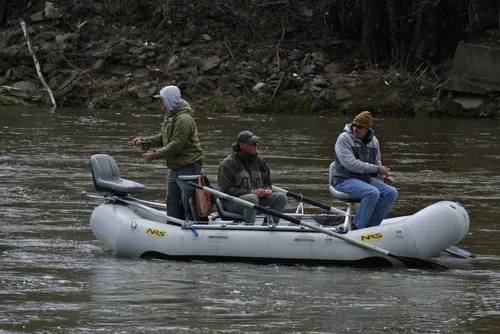
A raft is a whitewater inflatable usually outfitted with a frame and oars — used for fishing rivers.
Reach cast
A reach cast is used for adding extra slack in the line or when fishing downstream to provide a more natural float.
Redd
A redd is a hollow scooped in the sand or gravel of a riverbed by breeding trout or salmon as a spawning area.
Reel seat
The reel seat is the mechanism that holds the reel to the rod — usually using locking metal rings or sliding bands.
Refusal
A refusal is when a trout rises to inspect the fly and turns away without taking it. A refusal is useful information: a lighter tippet, a smaller fly, or a cleaner drag-free drift often turns the next rise into a take.
Retrieve
The retrieve is bringing the fly back toward the caster after the cast is made. Retrieves can be done in a variety of ways — the most important point is to keep the rod tip low and pointed straight down the line.
Riffle
A riffle is a quickened flow of water over smaller rocks or gravel at the head or tail of a pool — often a foot or less deep in late season. Riffles can be very productive when fished with a two-fly rig, often nymphs.
Riparian zone
Riparian describes anything inhabiting or situated on a riverbank — often used in connection with ownership and fishing rights.
Rise
Rise forms are the patterns a trout makes as it takes a fly. There are several distinctive rise forms including sipping rises, jumping rises, and tailing rises.
River load or water tension cast
A river load or water tension cast is one where the caster uses the river's current to load the rod. Let the line get straight and almost perpendicular to the rod tip. Point the rod toward the water and using a sidearm motion quickly move the rod toward the target. The force of the river's current combined with your motion against it will quickly load the fly rod.
Rod action
Rod action is an important characteristic of fly rods that helps you feel the cast better. Rod actions are typically fast, medium, or slow. Fast-action rods bend primarily at the tip enabling higher line speeds. Medium-action rods are ideal for overall freshwater fly fishing. Slow-action rods flex along their entire length and better protect lighter tippets.
Rod flex
Rod flex is the manner in which the rod bends during the acceleration phases of the cast — whether forward or back. Tip-flex rods bend primarily through the tip section. Mid-flex rods bend down into the middle section. Full-flex rods bend throughout the entire rod during the cast.
Roll cast
The roll cast is ideal for changing directions while fly fishing and can also be used to pick up the line off the water when using sink tips or heavy nymphs. The roll cast pickup is more efficient than false casting because it eliminates wasted casts back and forth.
Roly-poly retrieve
The roly-poly is a line retrieval method where your hands work in a small circle — alternately grabbing fly line at different rates. It is used on both still water and rivers.
Run
A run is a place where water flows between a bank and a rock or between two rocks. A run can have fast or slow current. If the run has several large rocks on one side trout can hold against the side of these rocks — and the same applies to bank areas.
Running line
Running line is the thin, level section of fly line behind the head. It shoots through the guides with little friction after the head is cast, adding distance.

S

S cast
An S cast is used to put deliberate and controlled slack into your presentation — used for achieving a drag-free float and in conjunction with mending line.
Scud
A scud is a small freshwater shrimp-like crustacean present in most trout waters that serves as an important food source for trout — very prevalent in spring creeks.
Sea-run fish
Sea-run trout and salmon hatch in freshwater, migrate to the sea to mature, and return to freshwater to spawn. Species include all types of salmon, brown trout, cutthroat, and rainbow trout. Rainbow trout in the Pacific Northwest and Great Lakes are the best-known sea-run trout — called steelhead.
Seam
A seam is where two current flows meet — one slower and one faster — ideal for holding trout. Fish often hang out in the slower flow and dart into the faster flow to capture food. Locate seams where obstacles like islands and large rocks disrupt the flow and divert the main current.
Setting the hook
Setting the hook is the act of pulling the hook into the fish's mouth. The amount of effort needed varies with hook size, fish species, and leader breaking strength. The general rule is that most anglers strike too hard on trout and warm-water fish and not hard enough on salmon and saltwater fish.
Shooting line
Shooting line is the process of lengthening your fly cast by releasing extra fly line during the cast. This technique allows you to cast with greater efficiency.
Shooting taper or shooting head
A shooting taper or shooting head is a short single-tapered fly line designed for longer casts with minimal effort. Shooting heads allow you to switch between different line types by quickly interchanging head sections. Most commonly used for salmon, steelhead, and saltwater species.
Single action fly reel
A single action fly reel is one in which a single turn of the handle causes one turn of the reel spool — differing from a multiplier reel where a single turn of the handle causes multiple turns of the spool.
Sink rate
Sink rate is the speed at which a sinking fly line sinks. There are at least six different sink rates for fly lines ranging from very slow to extremely fast.
Sink-tip fly line
A sink-tip fly line is a floating fly line with a sinking tip portion — available in 4-foot through 30-foot sinking tips. The 10-foot sink-tips are most commonly used. Sink-tip lines are especially effective for wet fly and streamer fishing.
Sinking fly line
A sinking fly line sinks along its full length at a rated speed, measured in inches per second. Sinking lines get streamers and wet flies down to fish holding deep in lakes, reservoirs, and big rivers.
Sipping rise
A sipping rise is the quiet trout rise that produces a circular waveform much like a rock dropped in a pool of water. This rise form may indicate a large trout feeding — especially at dawn or dusk.
Sow bug
A sow bug is an aquatic crustacean found in lakes, rivers, and streams worldwide. There are over 130 species of sow bugs in North America.
Spey cast
A Spey cast is a change-of-direction roll cast that uses a sustained anchor of line on the water to load the rod, with no back cast in the air. Named for the River Spey in Scotland, Spey casting lets anglers cover big water with high banks or trees behind them, using two-handed rods, switch rods, or single-hand rods.
Spinner
The spinner is the egg-laying stage of the mayfly life cycle — providing fast and furious angling. During this final stage the clear wings are held out horizontally. It is also the most overlooked occurrence on the water by many anglers.
Spinner fall
The spinner fall is the egg-laying swarm of mayflies — usually identified by clouds of spinners bouncing up and down over the water as they prepare to lay eggs. It is one of the most overlooked occurrences on the water by many anglers.
Splash rise
A splash rise is a fast, splashy take at the surface, usually to an emerging or fluttering insect such as a caddis trying to escape. Trout making splash rises often respond well to a fly that is skated or twitched.
Split cane rod construction
Split cane rods are fly rods constructed of six pieces of split cane bamboo — triangularly shaped, tapered, and glued together. Split cane rods originated in the US in the middle of the 19th century and many fine cane rods are still produced today.
Spooking a fish
Spooking a fish means alarming it so it stops feeding or flees, usually from a shadow, a heavy line landing, a careless wading wave, or movement on the bank. A spooked trout often stops feeding for a while, so a quiet, careful approach pays off before the first cast.
Spring creek
A spring creek gets its water from an underground aquifer or spring sources rather than glacier melt, snow melt, or surface runoff. Water temperatures in spring creeks remain more stable than traditional creeks and rivers because they are fed by underground water sources.
Stalking
Stalking is the action of creeping up on a fish so as not to surprise or disturb it.
Steelhead
Steelhead is a migratory rainbow trout — sea-run.
Stonefly
Stoneflies are a very important aquatic food source for trout at all stages of their life cycle. Stonefly nymphs live for one to three years depending on species. Most species hatch by crawling to the shoreline and emerging from their nymphal case above the surface. Stoneflies require a rocky stream bed with very good water quality.
Streamer fly
A streamer is a fly tied to imitate various species of baitfish upon which both freshwater and saltwater game fish feed. Streamers are large often heavily weighted flies that sink fast and have a natural swimming motion.
Strip-set
The strip-set is the act of stripping the line with the line hand to set the hook on a strike.
Stripping
Stripping is bringing in fly line with a series of short or varied pulls to simulate a living insect or baitfish — often involving movements of the rod tip. The key to successful fishing is having the ability to vary all types of retrievals for different speeds.
Stripping basket
A stripping basket is a container worn at the waist that holds stripped line between casts. It keeps line from tangling in surf, wind, rocks, or brush and makes long shooting casts easier, especially in saltwater.
Surgeon's knot
A surgeon's knot is an excellent knot used to tie two lengths of monofilament of dissimilar diameters together.
Switch rod
A switch rod is a two-handed fly rod, typically 10 to 12 feet, short enough to cast overhead or Spey cast. It is well suited to big rivers like the Tuckasegee and Nantahala for swinging wet flies and streamers or nymphing at distance.

T

Tag end of a knot
The tag end is the short, loose end of line left after tying a knot. Trim it close, but leave enough that the knot cannot slip.
Tailing rise
When feeding in shallow water you will often see a fish's caudal fin exposed. Tailing fish are an exciting discovery and generally signal the possibility of getting strikes with the proper presentation of the right fly.
Tailwater
The tailwater is the downstream section of a river or stream found below a large man-made dam. The most famous and productive tailwaters are from bottom-discharge dams which make the water relatively cold and consistent in temperature.
Tapered leader
A tapered leader is made of monofilament and used for fly fishing. The back or butt section of the leader has a diameter nearly as large as the fly line — becoming progressively smaller toward the tip end.
Terrestrial fly pattern
A terrestrial is a land-based insect that often serves as food for fish. Terrestrial activity is common during summer months. Late-summer grasshoppers, inchworms, beetles, and ants are all common examples of terrestrials.
Tight loop
A tight loop, also called a narrow loop, is a loop with little distance between the rod leg and the fly leg. Tight loops cut through wind and carry energy efficiently for distance and accuracy. They come from a straight rod tip path and a crisp stop.
Tight-line nymphing
Tight-line nymphing is any nymphing method that keeps the line and leader tight between rod tip and fly with no strike indicator, so the angler feels or sees strikes through the leader. It gives direct contact, fast strike detection, and precise depth control. Euro nymphing is one form of it.
Tippet
The tippet is the end section of a tapered leader away from the fly line where the fly is attached — the smallest diameter section of monofilament. Carry a number of spools of tippet in various diameters and breaking strengths to quickly match the situation.
Triangle taper fly line
A triangle taper is a continuous 40-foot taper profile to a fly line with a thinner running line. Triangle tapers make excellent roll-casting lines but poor distance lines because they turn over too quickly.
Trout Unlimited
Trout Unlimited is an organization dedicated to the protection and improvement of trout fisheries with an emphasis on wild trout.
Turn over
Turn over describes how the fly line and leader turn over at the completion of the cast — whether curved, slack, or straight.

U

Unloading the rod
Unloading the rod is the unbending of the rod that transfers the casting energy from the rod back into the fly line.

V

Variant fly pattern
A variant is a dry fly with hackles much larger than recommended — tied on conventional fly patterns.
Vest
A vest is a fly fisher's garment used to store gear such as fly boxes, tippet, and nippers while fly fishing.
Vise in fly tying
A vise is a tool with locking jaws for holding a hook when fly tying.

W

Wader belt
A wader belt is an adjustable belt cinched near the top of chest waders to keep out water — particularly recommended as a precaution in the event of a fall to prevent the waders from filling with water.
Waders
Waders are available in many styles and made of different waterproof fabrics. They come in two main types — boot foot with built-in boots and stocking foot requiring separate wading shoes. Boot-foot waders have built-in boots enabling you to just pull them on. Stocking-foot waders require a separate pair of wading shoes that generally provide better support and traction.
Wading boot
Wading boots are boots designed specifically to be worn over stocking-foot waders. Their soles are made of either felt or rubber and many are also stud-compatible.
Wading staff
A wading staff is a walking stick adapted to provide stability to a wading fly angler when moving through fast or deep water. Some wading staffs are foldable and can be kept in a fishing vest pocket until needed.
Warm water
Warm water is water too warm to support salmonids such as trout, char, and salmon. Common warm-water fish include panfish, bass, and carp.
Water tension cast
A water tension cast uses the tension of the water to assist in loading the rod while starting the casting stroke.
Weight forward fly line
A weight forward fly line carries most of its weight in the forward section. Instead of a level middle section like a double taper it quickly tapers down to a fine diameter running line — allowing it to shoot through the guides with less resistance for added distance. It is the most versatile fly line style.
Wet fly
A wet fly is any fly fished below the surface of the water — the forerunner of the nymph and streamer. A traditional style of fly tied with soft swept-back hackle and a backward-sweeping wing.
Wet fly swing
The wet fly swing is a typical presentation method in which flies swing across the water using all types of methods such as streamers, nymphs, wets, and even dries. It may imitate swimming mayflies, emerging caddis, and small fish.
Whitlock connection
The Whitlock connection is a method and tools for attaching a leader to fly line, repairing fly line, or making custom lines. It creates the smoothest connection overall — making nail knots and loop-to-loop connections obsolete for standard setups.
Wind knot
A wind knot is an overhand knot put in the leader by poor casting — a tailing loop. The term is a polite way to reassure new casters with the excuse of wind but wind has nothing to do with it.

X

X system for tippets
Used in conjunction with a number the letter X is a measurement designating the diameter of leader material. It refers to the diameter of a material rather than breaking strength. Subtract the X number from .011 inches to find the size — for example 4X is .007 inches in diameter. The smaller the X number the greater the diameter and the higher the breaking strength.

Z

Zinger
A zinger is a retractable device used to hang necessary items off your fly vest — such as nippers — to keep them out of the way when not in use.

Tags

adipose finsadultalbright knotanadromous fishangleranti-reverse reelarborarbor knotattractorback castbackingbadgerbarbbarblessbarrel knotbeadheadbellybelly boatbimini twistblankblood knotbobbinbraided loop connectorbreak offbrownbucktailbutt sectioncaddiscastCasting arc

Related Posts

Technique

Understand Rod Acceleration

Read →

Technique

Understanding the Fly Fishers Triad

Read →

Technique

Standardization in Fly Casting Today

Read →
© 2018 Mac Brown · macbrownflyfish.com. All rights reserved.

Monthly Fly Fishing Updates & Prizes

Updates from the River, Blog Posts, School Updates, Show Appearances, Gear Picks, Fly Selections, & More every Month.

Subscribe to the List