Improve Your Tracking for Fly Casting

Technique — April 11, 2016 — 5 min read — Updated June 9, 2026

Improve Your Tracking for Fly Casting

Tracking in fly casting has two distinct meanings — straight tracking, where the rod tip travels in a straight line without side-to-side wobble for accuracy and distance casting, and route tracking, where the rod tip deliberately deviates from straight to produce transverse waves for presentation casts including curve casts, pile casts, S-turns, and aerial mends. The most common tracking fault is wrist roll at the completion of the back cast — the reel points to the side instead of toward the target, introducing a wide transverse wave that carries forward and destroys the forward cast. Two tools fix this faster than any drill: Doug Swisher's pizza box tool and a red dot laser pointer.

Back to Blog
Improve Your Tracking for Fly Casting

Improve Your Tracking for Fly Casting Accuracy

Improving your tracking for fly casting accuracy is a topic I've wanted to cover for some time. The term "tracking" has many dictionary definitions, but in fly casting, it refers to a two-fold process describing either a straight path or the course the rod tip travels during the casting stroke. Learn more on our fly casting definition page.

Tracking– 1) A term used to describe the rod tip traveling in a straight line without side-to-side wobble during the casting stroke (see also rod wavering). 2) A course or route traveled by the rod tip during the casting stroke or line positioning drift, used to describe more advanced casts that deviate from straight.

The first tracking definition addresses the rod tip traveling in a straight line and is the most commonly used for accuracy. It applies to all skill levels of fly casting. Rod wavering is the term I use to describe side-to-side rod wobble during the casting stroke. Rod wavering is a casting fault when attempting straight-tip-path tracking. Tracking is a common challenge for new fly casters on the stream because they're still learning to cast a fly line straight. Many skilled anglers never move beyond this level of straight tracking. Maintaining straight tracking is a discipline for accuracy fly casters, which is perhaps why it receives so much attention.

fly-casting-spey-lessons-instruction-north-carolina

Using Waves for Fly Casting

The second tracking definition is used for more advanced casts that employ waves. In fly casting, the rod tip path often deviates from straight. This approach is controversial to many, but it's worth exploring! Now the tip path deals with three-dimensional rod tip paths. This can intimidate those accustomed to two-dimensional thinking. When you use these motions during the casting stroke, they become part of the overall casting motion, just like Zorro with his sword!

The important thing to remember is that we're influencing the fly leg of the loop when these motions are performed during the casting stroke. We call these transverse waves in the instructor community. Examples of presentation casts using these include multiple loop planes, S-turns, corkscrews, curve casts, pile casts, and many others!

When we perform waves right after the casting stroke, the transverse wave primarily affects the rod leg of the loop. These are called aerial mends. It's much easier to dial in the amount of mend you need for presentation casts while the line is in the air rather than waiting for it to land on the water. Why wait for a stack mend roll cast when you can do a quick wiggle of the tip in the air? Make it easy on yourself and master aerial mends. The progression usually starts here, and over time you'll learn to introduce them into the actual casting stroke for route tracking.
swishers-tracking-tool.jpg

Swisher's Plan-o-Matic Tool

Pizza Box Tool

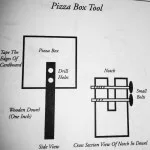
The pizza box tool was described to me during late-night fly-tying sessions in 1988 by its originator at Cottonwood Camp on the Big Horn River, my neighbors Doug Swisher and Carl Richards. The diagram below appears in my text "Casting Angles," and the tool is rightly named the pizza box tool or Swisher's tracking tool. It's a great corrective tool for major tracking issues. Their book "Selective Trout" was one of the biggest game-changers for the sport ever.

It's simply a large pizza box, a one-inch round dowel about 16 inches long, some duct tape, and a couple of short bolts. This simple design has helped me tremendously over the years when teaching groups to correct tracking flaws. The picture below explains it better than a verbal description and is one of the diagrams from my book "Casting Angles."

Pizza Box Swisher's Tracking Tool
fly-casting-accuracy-tracking.jpg

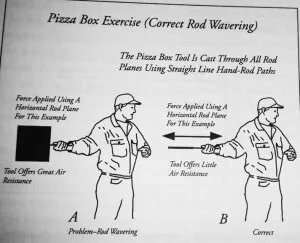
Correct Rod Wavering

If your hand deviates from a straight path, the air drag increases on the box, and you can really feel the difference! Many wrist-action fly casters who cast 25-30 feet struggle with longer distances. As soon as you extend to 40, 50, or 60 feet of line, major tracking issues often emerge. One common issue occurs toward the end of the backcast when the wrist rolls out. The reel points to the side rather than toward the target. This causes the line to swing around in a wide circle in the back, and that wild wave carries forward into the forward cast. This is where the pizza box really shines as a corrective aid.

Laser Pointer for Fly Casting

Another excellent corrective tool comes from my friend and fellow MCI instructor David Lambert from Jacksonville, Florida. David told me about this around 1995 at an FFI conclave. All you need is a simple laser pointer, like the inexpensive red-dot lasers available anywhere. The laser pointer works for both types of tracking described above. When you use this device with a large ceiling, it's like having a 40-foot rod! The red-dot laser really helps improve your straight tracking quickly. For example, stand next to a wall and make vertical casting strokes while following the laser dot on the ceiling—it's an excellent corrective tool. I prefer the laser for better understanding of route tracking. I hope these tracking tips help you perfect more accurate casts!

Tags

aerial mendsbig horn rivercarl richardscasting accuracycasting anglesCasting Strokecottonwood campDavid Lambertdoug swisherfly casting faultsfly leg of the looppizza box toolred dot lazerrod leg of the looproute trackingstraight trackingthree dimensional castingtrackingtransverse wavestwo dimensional casting

Frequently Asked Questions

What is tracking in fly casting?

Tracking in fly casting has two definitions. Straight tracking describes the rod tip traveling in a straight line without side-to-side wobble — the most commonly used definition, essential for accuracy and distance casting. Route tracking describes the course the rod tip deliberately travels during more advanced casts that deviate from straight — used for presentation casts that employ transverse waves including curve casts, pile casts, S-turns, corkscrews, and aerial mends.

What is rod wavering in fly casting?

Rod wavering is the term Mac Brown uses to describe side-to-side rod wobble during the casting stroke — a casting fault when straight-tip-path tracking is the goal. The most common cause is the wrist rolling outward at the completion of the back cast stop, causing the reel to point to the side rather than toward the target. This introduces a wide transverse wave into the fly leg of the loop that carries forward and destroys the accuracy of the forward cast. Many casters fish at 25-30 feet without detecting this fault — it only becomes obvious when extending to 40, 50, or 60 feet.

What is the pizza box tracking tool for fly casting?

The pizza box tool — also called Swisher's tracking tool — was developed by Doug Swisher and Carl Richards and described to Mac Brown during late-night fly tying sessions in 1988 at Cottonwood Camp on the Big Horn River. It is a large pizza box with a short dowel and duct tape that attaches to the rod hand — if the hand deviates from a straight path during the casting stroke, air drag on the box immediately reveals the deviation. The tool is illustrated in Mac Brown's book Casting Angles and remains one of the most effective group teaching aids for tracking correction available.

How does a laser pointer help improve fly casting tracking?

The laser pointer technique was shared with Mac Brown by fellow MCI instructor David Lambert around 1995 at an FFI conclave. A simple red dot laser attached to the rod creates a 40-foot rod effect on a large ceiling — the dot traces the exact path of the rod tip during the casting stroke with total visual clarity. Stand next to a wall and make vertical casting strokes while following the dot on the ceiling. Any deviation from a straight path is immediately visible. It works for both straight tracking and route tracking diagnosis.

What are aerial mends and how do they relate to tracking?

Aerial mends are transverse waves introduced to the fly line after the casting stroke — while the line is still in the air — to reposition the line without the fly touching water. They are far more precise and efficient than stack mends or roll cast mends made after the line lands. A quick wiggle of the rod tip in the air can accomplish what a stack mend roll cast requires after landing. Mastering aerial mends is the bridge between straight tracking and route tracking — and the entry point for the full range of three-dimensional presentation casts.

What is straight tracking versus route tracking in fly casting?

Straight tracking describes the rod tip traveling in a straight line without side-to-side wobble during the casting stroke — the most commonly used definition for accuracy casting at all skill levels. Route tracking describes the course the rod tip deliberately travels for more advanced casts that deviate from straight — used for three-dimensional casts including multiple loop planes, S-turns, corkscrews, curve casts, and pile casts.

What causes the wrist roll tracking fault in fly casting?

One common tracking fault occurs toward the end of the backcast when the wrist rolls out — the reel points to the side rather than toward the target. This causes the line to swing around in a wide circle in the back and that wild wave carries forward into the forward cast. Many wrist-action fly casters who cast 25-30 feet struggle with this fault as soon as they extend to 40, 50, or 60 feet of line.

What is the difference between transverse waves during the casting stroke versus after?

Transverse waves introduced during the casting stroke influence the fly leg of the loop — used for presentation casts including multiple loop planes, S-turns, corkscrews, curve casts, and pile casts. Transverse waves performed right after the casting stroke primarily affect the rod leg of the loop — these are called aerial mends.

Who originated the pizza box tracking tool?

The pizza box tool was originated by Doug Swisher and described to Mac Brown during late-night fly tying sessions in 1988 at Cottonwood Camp on the Big Horn River. The tool is rightly named the pizza box tool or Swisher's tracking tool and appears as a diagram in Mac Brown's book Casting Angles.

Who introduced the laser pointer technique for fly casting tracking?

The laser pointer technique was introduced to Mac Brown by fellow MCI instructor David Lambert from Jacksonville, Florida — shared around 1995 at an FFI conclave. A simple red-dot laser attached to the rod creates a 40-foot rod effect on a large ceiling. It works for both straight tracking and route tracking diagnosis.

Related Posts

Technique

Understand Rod Acceleration

Read →

Technique

Understanding the Fly Fishers Triad

Read →

Technique

Standardization in Fly Casting Today

Read →
© 2016 Mac Brown · macbrownflyfish.com. All rights reserved.

Monthly Fly Fishing Updates & Prizes

Updates from the River, Blog Posts, School Updates, Show Appearances, Gear Picks, Fly Selections, & More every Month.

Subscribe to the List