

Learning to Crack the Code in Trout Fishing
Over the past few months, I've had an exciting time teaching my oldest son, Connor, one of the most important attributes of fly fishing: learning to crack the code in trout fishing. This has helped him immensely avoid the many failures I made over the years, which has led to his greater success on the stream.
The most important thing for a kid learning to fly fish is the FUN factor. Fly casting and rigging on the stream are the easy part of trout fishing. Most surveys list these two disciplines at the very top of why the sport of fly fishing intimidates newcomers. It's best to begin with some sort of foundation casting to help prevent frustration down the road.
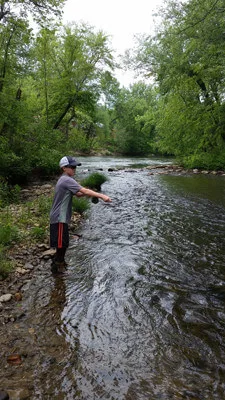
Fly Fishing the Bryson City Area for Trout
We all have to embrace the frustrating realization that we'll fail at times. We'd better make friends with our reaction to failing, learn from it, and move on. You see, "fail" is an acronym for First Attempt In Learning. The masses of tourists in springtime heading off to the river here provide classic examples of what not to do when fishing new waters.
Most of them flock to the nearest fly shop and think their success is directly related to fly pattern. Just imagine how silly that is—that the masses believe they've already learned techniques and tactics, figured out the water type, and tied on the magic fly from the local fly bin. Nothing could be further from the truth for most situations on the stream. Presentation and technique will always trump fly pattern. As light conditions, water clarity, time of day, and other factors change, we often adjust fly patterns more according to weight than worrying about what is hatching.
Most waters here in Western North Carolina have trout feeding opportunistically throughout the day. Trout exhibit feeding behavior that likes to sample the drift on stream, which means you should have a few nymph patterns in varying weights, dry flies, wet flies, and streamers. "Sample the drift" implies that trout do put your fly in their mouth to sample it for taste, action, texture, and perhaps they're just hungry.
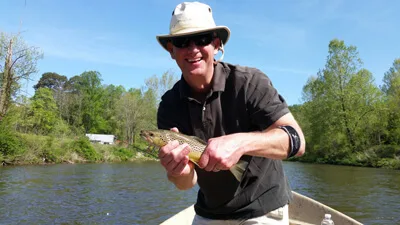
Spring Trout Fishing in North Carolina
Spring is a magical time in the Smokies for aggressive trout feeding in the wild. It's typical to have triple-digit days with trout on guided trips this time of year. It's important for folks to realize that as a guide, I can't predict it in advance, and there is no magic fly. What I can do is teach and assist you in learning to crack the code in trout fishing so you raise your skill level on future outings.
Many folks find it difficult to believe that most guided trips tend to be more productive with newcomers than with seasoned anglers—not the top-level elite fly fishers, but those who have been self-taught for most of their fly fishing journey. I tend to view rigging and casting as the mechanics of the sport, which can be learned rather quickly through proper foundational instruction.
What really fascinates me, though, is cracking the code when trout fishing. Observation is key for this to happen on the stream—it's like working a puzzle. When I think of the really top-level anglers I've met over the years, they have a very keen sense of observation and understanding of fish behavior.
Observation is Key for Trout Fishing
Cracking the code consistently while trout fishing requires that you learn from your mistakes early on as a fly fisher. If you don't embrace the failures on each and every outing, how will you improve? The water types where fish hold change throughout the seasons and even throughout the day. Once you know the water type, it's actually quite simple to determine if the fish are holding near the surface or tight to the bottom.
Next, you'll begin to receive clues that teach you about trout behavior. How close can you approach, and in what type of water? What type of action, or lack of action, does the fish want for the day? Is fly action determined by hatches, mood as it relates to conditions, or both? Cracking the code in trout fishing still fascinates me as much today as it did when I was a kid. This puzzle is most easily solved by keeping an open mind and a willingness to change up tactics or rigging as your instincts dictate in the moment on the stream.
Angling Pressure on Trout
Angling pressure changes things as well, because fish don't find it pleasant to struggle daily from being caught. In coaching fly fishing over the years, we often talk about water types as A, B, C, and D waters. These don't always remain the same when angling pressure increases on a resource.
One day, A water might give up three dozen trout on our local Delayed Harvest water. You can see those numbers diminish if you keep working the same water daily. The trout disperse and begin holding in the D waters once the others have been exhausted on a daily basis. Over time, C and D waters change into A and B waters. You have to fish in the moment and figure this out on each and every outing.
If you're lucky enough to live close to a trout stream, you're fortunate. Learn to fish the same section of stream often—one that has shallow riffles, pools, pocket water, and areas with plenty of cover. I have a few places on Deep Creek in Great Smoky Mountains National Park that I fish regularly through the winter months. The lessons I pick up from going to the same water also serve as a great study in how angling pressure causes fish to move around. Tight lines and happy fishing.