

The Road to Fly Fishing Mastery — Humility, Mentorship, and the Path Less Traveled
Learning to fly fish in North Carolina from a poem might sound a bit unconventional, but I've always been fond of Robert Frost's poem "Two roads diverge in a yellow wood" from The Road Not Taken. Last year, we had a visitor from Wodonga, Australia named George Forster who spent several weeks with us (pictured below). We hadn't heard of George before except through a few instructor forums for the Fly Fishers International.
George impressed me with his drive and enthusiasm—traveling halfway around the planet for total immersion in fly fishing! He tested for his Master Casting Instructor certificate from FFI at Western Carolina University in 2014. He exemplifies the type of person you instantly admire when you meet them. He was also a talented musician, which no doubt contributed to his ability to learn, teach, and discuss things at a very fast pace.
Continuing Education Fly Casting
We picked up many great Australian fly casting techniques from George that make certain teaching tasks much easier now. The three-day event was excellent for instructor continuing education, with Leslie Holmes, Steve Rajeff, Eric Cook, David Lambert, Tom Rueping, Paul Bourcq, Mac Brown, and many other talented folks sharing their knowledge!
David Lambert and I came up with the idea of offering continuing education (CE) in 1998 at the Southeastern FFI conclave at Callaway Gardens in Georgia. It has since become common for CE to be offered at FFI conclaves globally! Continuing education helps ensure that fly casting instruction continues to advance and evolve.
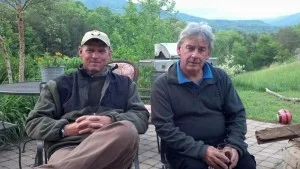 A long day at the SE FFI Conclave in Bryson City, North Carolina
Trout Fishing Road Not Taken
"The Road Not Taken" by Robert Frost parallels the philosophy of fly fishers around the globe. For me, the poem relates to the humility of fly fishers who share knowledge versus those content with mediocrity. Teaching, learning, and growing as a student of fly fishing is a journey of personal evolution in all aspects of the sport.
We've been blessed to teach fly fishing all over the world since college. Trout fishing instruction is fundamentally problem-solving—finding more effective teaching methods. The "school of hard knocks" is powerful because it helps us appreciate the deeper concepts of angling. I'm deeply indebted to the many instructors worldwide who have shared their knowledge with me. Fly fishing is one of the most literate sports out there! Fly fishers choose to walk either the road of humility or the road of pride.
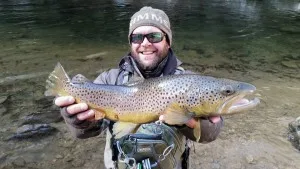 Nick Johnson on the Upper Nantahala Delayed Harvest
Trout Fishing Failure Is Key to Success
Those who choose the road of humility aren't afraid to fail! FAIL is an acronym for First Attempt In Learning. The more you fail, the closer success is at hand! These new learning experiences lead to greater success the next time you're on the stream. Past experiences help you make new discoveries. Ask questions to improve your trout fishing—whether about fly patterns, tactics, techniques, casting, or anything else that applies to angling.
The best anglers and fly casters are willing to share information freely rather than hoard it. Embrace your failures; they're your finest teacher and will help you appreciate your successes later. Fly fishing requires this problem-solving approach on the water.
Jim Green and Fly Casting
My mentors over the years were generous with sharing information. All that was required was asking questions. Jim Green was one of my biggest influences as a teenager. I knew fly fishing would become my career when I graduated from Westminster College. Jim would often write six-page letters (front and back) explaining topics related to fly casting.
This man, who started the graphite rod revolution at Fenwick, worked for years at the Sunset line company, and held the World Champion casting title with many casting merits, shared his knowledge generously. Jim was born in 1920, so my goal was to practice everything he explained until it made sense. Some topics took me a very long time to fully understand, given that he had 43 years of experience on me. He was and always will be a legend to me for being such a classy individual and taking the time to share.
Camp Creek Trout Fishing Ninja
Another mentor from my youth was an old tobacco farmer on Camp Creek in Greene County, Tennessee. When I was eight years old, he offered me a handful of Red Tagged Daiwl Bachs. He became my hero from that moment on, even though we never saw each other again! He was very skilled at catching nice trout using Daiwl Bach patterns. For decades, I thought he had invented the pattern. I was surprised to later discover it had been around for nearly 400 years in Ireland!
Fly fishers who choose the road of pride set themselves up for disappointment every time they hit the stream—much like in life itself. Prideful anglers constantly exaggerate great tales from the river. They get stuck in trees and on riverbanks most of the day, thinking that's normal, when the reality is their casting still looks like a beginner's. They disappear around the bend when they see someone doing well on the stream. They fish with a thingamabobber every time because it's their only tactic. There's nothing wrong with floating indicators—they have their place when the time is right! But prideful anglers make excuses constantly, yet remain too proud to ever ask for help.
But I Fished Alaska!
We've all had the client who's a self-proclaimed expert after fishing Alaska once! We call this a guide's worst nightmare. You won't be able to teach this person anything! He already knows too much from his one-time adventure fishing in a place where a bare hook would work. Pride blocks people's ability to learn new things. The creel study backs this up if you need more proof.
The study showed that only .003 of anglers caught significantly more trout. When those surveyed were asked about their skill level, over 40 percent claimed to be advanced intermediates, and 35 percent claimed to be advanced! Over three-quarters of the fly fishers surveyed thought much more highly of themselves than their actual results showed. Most of them are probably still at the same level today.
Many prideful fly fishers will remain in denial that the creel study is legitimate. The results you achieve on the road you choose are totally your decision. Choose wisely because there are already plenty of prideful folks out there on the stream. You've probably already met a few. The road to improvement is entirely up to you and what you choose to do about it.
Instruction Is the Best Fly Fishing Investment
The best dollars you can spend are on quality instruction to ensure you practice what matters. If you can't afford it, make a point to fish with those much better than you and swallow your pride. Take a kid fishing this spring, and you'll find it much more rewarding to help them build solid fundamentals.