

What makes a great fly fishing leader? After nearly four decades of guiding and teaching on Smoky Mountain streams, my answer is always the same — it depends on what you want it to do. Leader construction is not about memorizing a single formula. It is about understanding energy transfer, material stiffness, and taper design well enough to make smart adjustments right on the stream. Get that foundation right and every technique you fish — dry fly, nymph, streamer, wet fly — becomes more effective immediately.
Understanding Energy Transfer
Leader length plays a big role in how energy moves through the system. Leaders range from a short straight section of tippet all the way to over 30 feet for far and fine presentations. This goes well beyond the standard butt, mid, and tippet sections most anglers learn at the start.
Longer leaders open up a world of presentation options on the water. Greater length gives you more control over mends, better stealth, and more accuracy in technical situations. I would suggest starting with a minimum of 12′–16′ of Maxima Chameleon for added stiffness, accuracy, stealth, and easier line mends for dry fly or dry-dropper fishing. Once you are confident in your casting, this setup will take your presentations to another level. The range I prefer is 16′–24′ on smaller streams, up to 32′ or more on tailwaters with spooky trout. Also take a look at the tippet page—your tippet is the critical link between you and the fish.
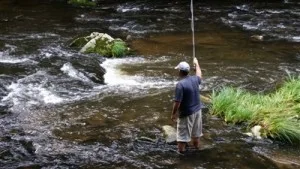
George Forster from Wodonga, Australia, high-sticking pockets on the Nantahala River
Maxima Chameleon Stiff Leaders
For trout fishing in the Western NC Smokies, I rely on Maxima Chameleon. The stiff material is very precise for accuracy, which is essential in tight pocket water. My go-to setup is a .017 butt section of about 12′ of Maxima Chameleon, tapered down through a sighter from .015 to .011, then straight fluorocarbon tippet to the fly. It is a very accurate casting leader. If you try a Dave Whitlock connection to join this setup to your fly line, I think you will love how smoothly it shoots out without any bumps at the connection point.
The butt section of the leader should match the stiffness of the fly line you are joining it to. With a three-weight fly line, .017 Chameleon typically matches up well. If you move up to an eight-weight, the butt section might jump to .022. A simple way to check the match is to hold the butt material and the fly line together for about 5 inches and observe the sag profile. When they bend similarly, you have a good stiffness match.
Leader Attributes
The three key attributes to understand when building leaders are stiffness, weight, and diameter. If you want efficient energy transfer, use stiffer material with a longer butt section. It is also worth remembering that we rarely use the same leader for nymphs, streamers, wets, and dry flies. A taper designed to turn a dry fly over with some slack is a completely different setup from a straight nymph rig built to sink fast. Dry flies have a high air-drag profile; nymphs and streamers carry momentum from their added weight and cut through the air differently. Matching the leader design to the technique is where things get really fun.
Match Fly Line to Leader Material Stiffness
Use the feel test to match fly line stiffness to your leader butt. The same 12′ leader will behave very differently on a two-weight versus a seven-weight setup. For very long leaders, furled leaders made from Spectra, Dyneema, or Kevlar are worth exploring. You can vary the mono attachment point to dial in the air-drag profile you need, and you can taper sections of Dyneema right down to the tippet. These materials perform exceptionally well, and I think anglers who discover them rarely go back.
If you notice twist kinks forming near the tippet with a dry fly, it usually means the tippet section is too long or too supple. The fix is straightforward: use stiffer or larger-diameter mono, shorten the tippet, or lengthen the graduation sections. Any combination of these will get things turning over cleanly again.
Slack and Non-Slack Leaders
Why would you want a dry fly leader to transfer energy very efficiently? The answer is when you need positive curve casts to turn the corner with fly, leader, and line for precise control into a prime lie. A highly efficient leader also calls for a higher level of casting finesse—which is a wonderful skill to develop over time. Understanding when to use slack versus non-slack designs gives you a real advantage on the water as conditions change throughout the day.
Furling Leaders
A solid understanding of energy transfer will serve you far better on the stream than memorizing any single leader formula. I grew up fishing Harvey-style leaders and think they are excellent. The truth is, there are hundreds of great formulas out there, and every one of them has something to offer. No single leader does everything perfectly—and that is actually good news because it means there is always something new to learn and experiment with.
Furling your own leaders is a rewarding skill to pick up. Furled leaders offer a smooth, consistent energy transfer that is hard to match with mono alone, and they are especially effective for most trout fishing situations.
A great introductory article by Henk Verhaar:
globalflyfisher.com/fishbetter/henk/henk1.htm
One tip for building pegboards: label them from 9′ to 16′ using an A, B, C system so you can use the same board for multiple lengths. Varying the number of loops lets you experiment with different tapers. Once you are comfortable, use a spreadsheet to track peg placement and dial in your favorite formulas.
Dyneema and Kevlar for Furled Leaders
Power Pro and Spiderwire Fusion both work excellently for furled leaders. I have had one on my two-weight rod for over three seasons, and it still performs beautifully. Superline materials do require more upfront investment—it takes about 125 yards to make two 12′ leaders—but the durability more than makes up for it over time.
Another advantage of furling is the ability to build custom tapered running lines for long-distance shooting heads. A short taper at the head connection point strengthens the launch and prevents break-off during aggressive casts. Once you have the technique dialed in, you can build running lines to any spec right in your backyard.
Passive Leaders
Here are some leader formulas I have used and trusted for a long time (passive leaders). I encourage you to experiment with construction based on what you are trying to accomplish. For a long-line nymph rig where you need the flies to reach the bottom quickly, use material that sinks, keep the tippet long relative to the depth you are fishing, and go small in diameter for a faster sink rate. You could easily end up running 5–12 feet of tippet to get the rig perfectly tuned for a specific situation.
Leader Formulas—Free Downloads
Leader Formulas PDF | Furled Leaders Excel | Passive Leaders Excel