

Learn to Hammer Trout with Dry Fly Techniques
Learning to hammer trout with dry fly techniques is a very enjoyable method to catch trout. Most anglers in my part of the country tend to neglect fishing the surface. Tight lining with nymphs is no doubt a very productive technique overall. It can put countless numbers of fish in the net. I started my kids at three years old because it is simple and offers a high level of control. Many start there and never move on to the next level because it works. It is easy and fits well with the "cookie-cutter" approach of instant gratification—fishing only a rod length away on heavily stocked waters for hatchery-raised trout. learn dry fly techniques
It's time to move on, time to get going (lyrics from the late Tom Petty). I do believe that the challenges of achieving proper drifts in dry fly fishing are a natural progression. The action of watching a fish feed in the film is exciting! Developing the skill set to make the fish eat will require some work. Centuries of anglers and literature have debated techniques with sometimes elitist attitudes. This is not an attempt to revive the Halford and Skues debate on nymphs versus dries. Familiarize yourself with terms and techniques early on to accelerate your skills. learn dry fly techniques
Push Your Trout Fishing Skills
This is about motivating folks to push ahead and keep learning! Do not get complacent just because you can tight line a few fresh hatchery trout from under your rod tip. Plod ahead on your fly fishing journey! There are plenty of anglers today who skillfully lob bobbers at very short distances. If that appeals to you, then this piece probably is not for you.
I believe strongly that a well-rounded fly fishing journey includes all techniques—wets, nymphs, dries, and streamers. They all have nuances requiring you to adjust the cast itself to achieve the desired outcome. Many of the problems fly fishers face globally stem from regressions in concepts that have set us back over the past few decades. There is no doubt in my mind that there is a global community of passionate teachers taking this very seriously.
One of the biggest challenges to raising the bar comes from many iconic figures who are still holding it back with bad information delivered incorrectly for "perfect practice" sessions. If we build the foundation of casting on incorrect assumptions, it becomes difficult to abandon them over time. They become your default—hence the problem. Think about that for a second! I think tradition is partly responsible for always addressing casting as a vertical 10-2 stroke as the grail of the sport. It instills the wrong foundation because it becomes a default!
Commit to Learning About Your Cast
We can teach the PULD cast (traditional method) in just a few minutes. If that is all you take away, then you are not even in the game for solving problems on the water. Your objective as a caster has to break away quickly from simply getting it out there. The goal now becomes to get it out there with the proper layout! Most folks assume they are progressing once they can cast distance. This is the wrong approach and will not lead you to the presentations you desire in the long run. You must commit to maximizing your journey through this great sport. That translates to actually practicing both off and on the water! learn dry fly techniques
You are well on your way to dry fly fishing when you can execute curves left and right or pile casts from all rod planes and loop planes in practice. It will empower you to achieve excellent "presentation," matching obstacles and water current to actually enjoy your time on the water. The other benefit is you will rarely get stuck in foliage or spend all day tying knots on the water! I have been blessed over the past few decades with dedicated clients taking this journey who return eight to ten times per year.
Combat Fishing Trips
I have little use for what I call "combat fishing trips" with folks who do not want to learn about the sport. These anglers tend to be content catching a few trout by lobbing a bobber all day ten feet away. The sad thing is they have no interest in improving, and that is why I look elsewhere for filling my calendar with teaching. How can you teach when they have no incentive to learn?
Everyone understands what a bell curve represents. Do you want to remain in the middle of that curve, more concerned about just getting it out there? Do you want to commit to learning enough about the sport so you can enjoy it all over the globe and solve problems? The really accomplished mentors I know all over the globe are only concerned with being far out on the edges of the curve. They constantly strive to better their understanding and skill level. They seek new boundaries and share this with others.
Trout Fishing Is About Sharing Information
There have always been two kinds of anglers in the sport. First, those who take information and regurgitate it as if they invented it (the "me, me, I want to be" icons). Second, inventors who truly want to share with others the foundation that empowers them to be great. Most of my casting geek friends who really want to change the sport for the better are spread throughout the globe.
Times They Are a Changing!
We have better fly lines, fly rods, mono, and flies than ever before in America. We also have a massive regression in competency among the number of fly fishers I see visiting my region or the famous rivers of the west. What is the solution to pushing forward? Why do so many retailers constantly advertise that "fly fishing is so easy" and offer free casting lessons? The big chain retailers (without mentioning names) are directly responsible for this overall regression.
I have always been an avid follower of Bob Dylan because of his brilliant ability as a wordsmith. Some of the most important words ever written reflect his crafty use of language. The lyrics to "The Times They Are a Changing" can apply just as easily to setting your bar high for becoming a very efficient fly fisher. I highlight the last few lines of the song that apply to the fly fisher.
"Come mothers and fathers throughout the land; And don't criticize what you can't understand; Your sons and your daughters are beyond your command; Your old road is rapidly agin'; Please get out of the new one if you can't lend your hand; For the times they are a-changin'.
The line it is drawn, the curse it is cast; The slow one now will later be fast; As the present now will later be past; The order is rapidly fadin', and the first one now will later be last, for the times they are a-changin'." —Bob Dylan
Slow Down the Cast & Think Smooth
Smooth your fly cast out to deliver s—l—o—w! Dry fly fishing is about finesse and casts that solve difficult circumstances. When teaching, many tell me they are advanced fly fishers, but their deliveries are too quick, which makes it difficult to find their dry flies on the water because turnover happens so rapidly. Learn to do the opposite, and you will enjoy it! Three and a half decades of teaching has shown me that this is the number one problem for those embarking on the journey of fishing the surface.
Also, slow down your approach. How many times do I see folks do nothing but flip fly line back and forth? Look more and cast less. You will generate more strikes because then you have a goal for your presentation. You can also pick out the singular fish you want to catch! Dry fly fishing is not about whipping the line back and forth. In fact, most of your casting strokes should consist of a setup move followed by a delivery cast. Delivery usually involves one of three methods: curve casts right and left, or pile casts. On rare occasions, you may target a rising fish with a straight cast, but it is not as common as the first three.
Tiny Flies for Winter Trout Fishing
Winter fishing offers excellent opportunities for small dry fly fishing with BWO hatches and midges. The best method for working a fly in these conditions is to rest after netting a fish to let the pod continue its feeding frenzy. Fish are alerted each time you hook one up. Beginners tend to throw right back into the pod after a hookup. This reckless method is a sure-fire way to put them down in a hurry.
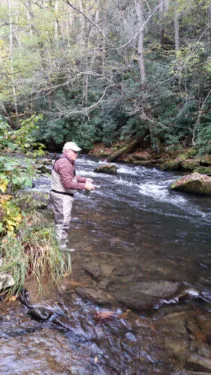
Recognize Rise Forms on the Strike to Learn Dry Fly Techniques
Fish are very attuned to their surroundings. Small fish create a much greater disturbance on the water when taking your fly. Really good dry fly anglers—like my friend Jim Estes from Bryson City, who taught me over three decades ago—learn to differentiate the quality of fish by the manner in which it strikes. The higher-quality trout you want to catch take the dry fly with very little disturbance on the surface. Set the hook! It takes a great deal of time actually fishing to learn this.
Relax and do not be overly trigger-happy about hook setting everything that strikes! This discipline takes many years to implement, but you can make it one of your goals. The reason it enables you to see much greater quality fish is that it does not disturb the water! Everyone wants to catch big trout. Very few have developed the skill set to do that with any consistency.
These subtle observations from three and a half decades of teaching techniques and casting have shown me that these are the main things to correct for most anglers. You will jump ahead of the curve by implementing them on the water.