

Learning the Double Haul
Learning the double haul for fly casting will help you achieve increased line speed! A haul is a method that involves a slight tug on the fly line during the acceleration phase of the fly cast with your line hand. Why do you need to learn a haul? The haul causes a direct increase in line velocity. The haul is usually a mirror image of the rod hand rotation. The rod hand rotation is similar to flicking water off a paintbrush. The abrupt stopping motion is what determines how much water is thrown from the brush. This analogy is usually helpful for those new to the sport.
The haul increases line velocity by moving the fly line a fixed amount (which varies due to rod action) and deepens the rod flex. It's the direct way to increase line velocity and line tension overall. It also affects several other dynamics of the overall casting stroke, but we'll explore that another time.
Single Haul
If the haul is performed only during the forward or backward cast, it's called a single haul. Typically, this method is used in the forward direction because the forward cast is usually the delivery cast and often requires the angler to shoot more line—which increases distance.
Double Haul Animation—Vertical Rod Plane
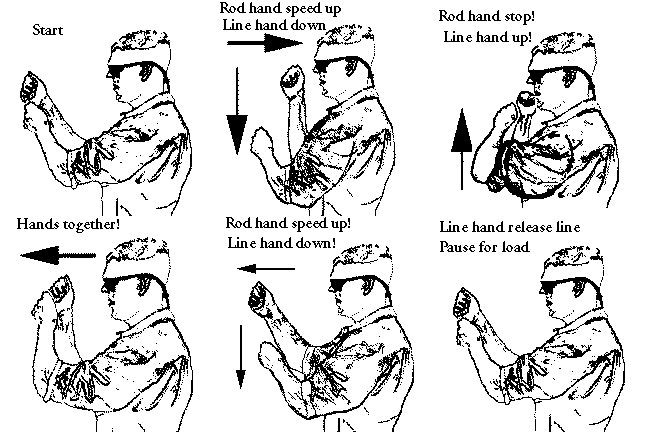
Pantomime the Motion of the Haul
If the haul is a new concept for you, follow along with the animation until your hands master the motion. I almost always introduce the haul by having students follow along using just their hands. Mel Krieger used the "pantomime" method often for teaching fly casting. It may also help to use a mirror and go slowly through the motion until it becomes second nature.
Another great teaching trick is to use a large rubber band attached to your index fingers. Go through the motion slowly, and the rubber band reminds you to bring your hands back together after you pull them apart. The most common problem I see is when anglers pull their hands apart on the backcast but fail to get the line hand back to the ready position on the forward cast.
The Haul Is Natural for the Back Cast
Most anglers tend to master the slight tug in the rearward direction naturally, since the rod hand moves away from the line hand instinctively. However, tension decreases on the following forward stroke when the line hand remains static.
The single haul more than doubles the line velocity on the forward cast when performed correctly. The animation at the top of the page illustrates the single haul if you concentrate on only the forward or backward casting motion—but not both.
Double Haul
The double haul is a single haul on both the forward and backcast. Study the diagram above closely to ensure you have the timing memorized. Learn the technique completely in your mind through visualization before you even pick up a rod. Pantomime the motion slowly without a rod by studying the animation. This will train your motor skills for your line hand duties.
Stop and analyze your performance in each direction. Start with about 30 feet of line in front while performing the backcast. Come to the abrupt stop and pause to diagnose your stroke. If the timing was off, simply turn around and face the line, which allows you to perform another backcast. Repeat this until you feel comfortable with the timing. This is also a practical method for developing loop control. Another helpful trick is to think about the haul beginning around the halfway point through the stroke.
Pantomime S–L–O–W–L–Y
The animation should help you visualize the sequence of proper double hauling technique while using a vertical casting plane. The line hand usually pulls the line parallel to the forearm of the rod hand and in the opposite direction from the rod tip. This simple rule will help you when applying the double haul throughout all casting planes. When learning, practice pulling small increments at a time for most casts. The length and speed of the pull from the line hand determine how much line speed you generate.
Have You Mastered the Double Haul?
One method for testing your abilities is to cast using a horizontal rod plane just inches from the ground and try to keep the line from hitting the grass. If the fly line hits repeatedly, return to the beginning stages listed above. Budding casters often learn this technique quicker than seasoned anglers simply because they learned it correctly from the start.
Another great learning tool for witnessing the timing of the double haul is to cast the rod using a horizontal rod plane with the butt resting against your stomach. Rotate your torso and cast the line using only the double haul motions. This exercise uses no wrist or forearm motion from the rod hand while making the cast, and it enables you to see the forward and backward casts throughout the stroke.
Shooting Line
Shooting line occurs when the caster releases the fly line. Some say this happens after the rod has come to a complete stop, while others say it happens toward the completion of the stroke—both can work. Anglers typically want the ability to make long-distance casts, which is just one reason for mastering this technique. Understanding shooting line is essential for efficiency in all casts. All fly casts gain distance as the loop unrolls toward the target area.
Once the loop straightens, the fly line can't carry any more line. Learning to haul and shoot line is essential! Both techniques enable you to conserve energy for all casting distances while eliminating the need for false casts. When mastered properly, your efficiency increases rapidly when making presentations on the water. You'll be able to make presentations with just one false cast for the backcast followed by the delivery cast.
Timing of Shooting Line for Presentation Casts
Are you ready for a more advanced appreciation of shooting line? Learn to shoot line early or late for more control opportunities over your layout. For example, if you shoot line late during a positive curve cast, you can create a question mark layout rather than the normal 90-degree curve.
An in-depth look at hauling in various rod planes is included in the book Casting Angles. The line velocities are also calculated to illustrate the differences between the basic cast, single haul, and double haul techniques. Good luck perfecting these techniques!