

History of Tight Line Techniques
Learn tight line techniques (Euro-nymphing) to increase your hookups on the stream! Tight line nymph fishing has been around much longer than most anglers realize. Some would say it goes back to the earliest forms of fishing thousands of years ago!
One of my mentors and friends, the late Jim Green, was the line designer for Sunset Line Company. Sunset Line Company has manufactured Amnesia orange and green colored mono for a very long time. It was the preference for many tight line fly fishers for decades. Jim also created the movement toward graphite rods in the 1970s. His influence is evident today in fly line taper configurations and casting techniques! Jim was a legendary fly fisher!
Other notable anglers who used tight line techniques long before the Euro nymphing craze include Jim Estes (an excellent angler from Bryson City, NC) and Joe Humphreys (Penn State fly fisher). Many of us at that time wanted a very skinny fly line for tight line techniques because it had fewer memory coils and handled better than straight mono rigs.
Leon Chandler at Cortland Lines answered this demand with a level line of .018 thickness. These were available in the mid-1980s, and I was an instant fan. The Cortland level line is still my preference today for fishing distances of 40 feet and closer.
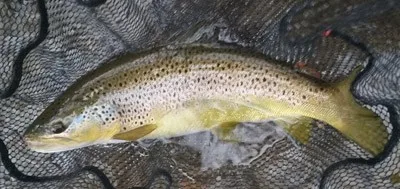
Competition Scene and Tight Line Fishing
Around 2005, many fly fishers started calling this same technique Euro nymphing. This movement emerged from Team USA competition anglers who witnessed the effectiveness of Euro nymphing in the FIPS-Mouche World Championships. Polish, French, Czech, and Spanish anglers all put their various twists on what I still consider tight line nymph fishing.
Modern terminology goes as far as stating that light flies fished far away are more indicative of Spanish style, while heavy flies fished deep correlate to the popular Czech style. And it goes on and on, which, frankly, is absurd in my humble opinion. In fly fishing, it's common to use many different sizes and weights of flies depending on the type of water, fish mood, and other conditions.
American Tight Line History
Many authors detailed illustrations in the early 1970s for rigging tandem or triple rigs depending on where fish may be feeding. They also explained the advantages of single flies for pocket water nymph fishing. So, this whole Euro-nymphing marketing campaign is truly a repackaging of tight line methods! It's still good for the sport if young people discover they've found a new way to fish!
If I had to pick one area of fly fishing that has changed me the most, it would have to be European influence on my fly tying! I still find myself getting fresh ideas from many excellent fly tiers all over Europe. The internet is undoubtedly responsible for much of this exchange of information. I'm just grateful so many of them are willing to share such excellent patterns.
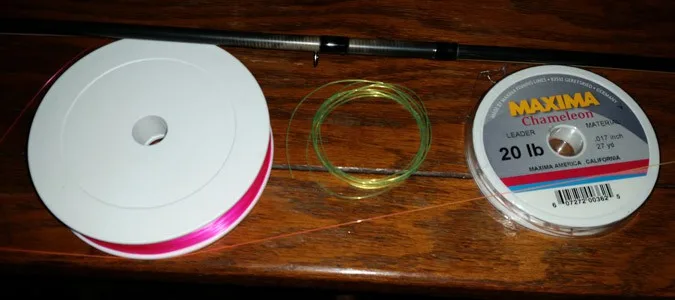
Maxima pink on left, Amnesia green in middle, Cortland bi-color lower, and Maxima Chameleon for building leader attached to fly line.
Advantages of Tight Lining (Euro-Nymphing)
The main advantage of the tight line technique is that you have more control over your flies when tippet rides on the surface. Tippet offers a better drift than a bobber tugging the nymphs along since current speeds differ greatly from the surface to the bottom. Think of your tippet like a parachute—the difference in diameter greatly affects your ability to sink small flies. If you're using heavy flies, it becomes less of a consideration in bigger water.
If I had to pick one of the biggest advantages of light level lines coupled with 2 and 3 weight long fly rods, it would be easy to answer: sensitivity is increased! Sound is transferred through vibration. A long light rod using lighter line (even lighter mono) will transfer sound through vibration much quicker than a standard heavier rod using a traditional fly line.
The sag of traditional lines becomes a problem for tight line techniques because it interrupts the drift—the fly line is simply too heavy. Vibration transmission is also reduced with heavy traditional lines. The transmittance of subtle vibrations is superior to anything else when fishing close (36 feet and less) because you're in control. There will always be many choices on the stream, and I'm in no way knocking the traditional modern lines out there today! They're needed when greater distance is desirable. Many examples of water exist where they excel, so they have their places!
Reduce the Tippet When Needed
A small tippet penetrates the water's surface to keep you in contact with your flies because it's more directly "inline." When you attach an indicator float, the nymphs get pulled along at a faster rate. The water's surface moves quicker than the deeper currents.
The rod angle and rate at which you follow or stop the drifts dictate how deep your flies are under the surface. For example, when you stop a fly heading downstream of your position, the fly will lift back toward the surface. When you feed straight downstream, the fly sinks quickly. There are many ways to sink flies quickly—a Tuck cast, a lift and reset, or an angle change, to name a few.
Learn What Depth Your Nymphs Are in the Water
When I think about the many elite nymph fishermen I've known over the years, the one thing that separates them instantly from the masses is they have total control over the depth they're fishing. Learning tight line techniques (Euro-nymphing) is the best way to develop this skill. Your time on the water is far more critical than any video or book. There are many methods to accomplish this task, with more information available in the article "Learn to nymph fish".
The trend throughout the USA is to use an indicator for nymph fishing. Bobbers must match the size of flies you fish, hence there are many different sizes. They may not be as stealthy when casting to new water. When you fish water far away, they excel because you can cover lots of likely fish locations (drift lanes).
Tight line techniques keep you in contact with your flies, so fishing by "feel" is better. It also enables the angler to make fewer adjustments on the stream because you can match your setup for varying water depths. Tight lining excels in pocket water situations because you can implement more techniques—such as the basic lift, jig, swing, rate of retrieval, and dead drift for your presentation.
Rigging Variations
The three-fly rig may at times use a dry fly to suspend the other offerings. Be creative with your rigging and fish many different combinations. For example, I often use a small dry fly on the point with a few droppers back toward the rod on the leader. The reason is the mono will suspend those flies on the dropper and keep them at the level where the fish are feeding.
For a stealthy sighter that floats, I often use the small tags left where I join mono together. This is an old-school technique of leaving small tags on plain mono leader rigs. These small greased tags are quick to add when building the leader. This is a deadly tactic when fish are feeding on emergers in the film.
Light flies can be fished farther away by using your favorite floatant to grease just the sighter (many prefer Mucilin). I prefer my own homemade floatant because it stays on the monofilament material better. Sighter material in hot orange and chartreuse is made by the Cortland Line Company in America. Hanak offers the brightest colors from Europe.
Give tight lining a try on your next outing to increase your catch! It surely has its place in all types of water for all species! Many young people who grew up fishing with bait find this transition to be a natural progression. The detection and ability to impart lifts, jigs, swings, and dead drift presentations is very similar!