Learning to Nymph Fish

Technique — March 23, 2015 — 6 min read — Updated October 5, 2026

Learning to Nymph Fish

Learning to nymph fish is the single fastest way to increase your trout catch — trout feed subsurface 80-90% of the time, making nymph fishing the most consistently productive technique in fly fishing. Mac Brown has been nymph fishing the Nantahala River and wild streams of the Smoky Mountains since 1987, developing proactive approaches including the induced strike countdown method, David Woody's jigging technique, wet fly line control at distance, and the six-cast rule for quickly solving the puzzle on any stream. The biggest determining factor for success is how quickly you adjust to fish behavior on any given day — not which fly you are using.

Back to Blog
Learning to Nymph Fish

Josh Stephens fly fishing the Nantahala River

Learning to nymph fish is a smart choice for any fly fisher who wants to increase their catch! Another article on nymph fishing can be found here on the site. Nymph fishing has seen many improvements over the past few decades. Innovation has come in many forms regarding rigging, yet many old-school techniques remain effective. The biggest determining factor for your success will be how quickly you adjust to the behavior of the fish on that given day. The beautiful Smoky Mountains town of Bryson City, NC offers some of the best trout fishing waters in the state!

Be prepared for your adjustments to change throughout the day, as conditions rarely remain the same. What do proactive methods mean to you? Many anglers use suspender devices (bobbers come in many shapes and sizes) for all their nymphing. There can be a time and place for this technique, but it is not the only productive method. The very best anglers I have met over the years have a huge arsenal of different techniques on the water. Below, we'll discuss various methods for becoming more proactive on the stream.

Observation of Trout & Activity

The puzzle is not difficult to solve in most circumstances: trout either hold tight to the bottom or suspend to feed higher up in the water column. Observation should tell you these clues rather quickly by studying the water and watching the fish. Fish moods change often, along with how far they are willing to move to eat something on a dead drift versus how much they will chase.

When fish are willing to chase recklessly, they become very easy to take advantage of on the stream. Learning to nymph fish enables you to capitalize on the various behaviors of the trout you pursue. There are times when the feeding is so heavy that very few things pass by without the fish sampling your offering. These times tend to be the greatest activity.

Be Proactive & Make It Happen!

What does it mean to become more proactive on the water? Do you dead drift, swing, jig, slow lift, induce a strike, and pepper the water in grids—to name a few? These are methods for being more in tune with solving the puzzle on the stream. Dead drifting and bobber fishing tend to be the most popular approaches here in America. Dead drift simply means allowing the flies to flow with the current. The swing implies the line has a curve on the water and moves the flies across the current.

Suspender fishing (bobber) may limit opportunities because it is fixed at a set distance. However, it offers advantages for fishing far away (over 35 feet). These other methods can be much more effective for fishing close (under 35 feet). Jim Leisenring is credited in America with writing about lifting flies through the water column in the 1940s. There are times when nymphing where the only way to induce fish to eat is by lifting the flies through the water column.

David Woody, from Andrews, NC, is one of the best I know at jigging flies through the water column. I learned this technique from him many years ago, watching him move the rod tip in small circles as the flies straighten well below him. This imparts small, forward, erratic movements to the flies as they ascend. His style of jigging flies has influenced many anglers in and around western NC.
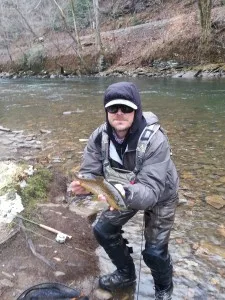
nantahala-river-brown-trout-roberts.jpgCorey Roberts with a nice Nantahala brown trout nymphing a run in February

Induced Strike Method of Nymphing

The induced strike works best when there is heavy feeding on the stream and the fish take the flies on the descent in the water column. I use a countdown, usually between one and five seconds, and then go straight into a hook set or backcast and throw right back into the area. I learned this in the early '90s on the Nantahala River when nymphing short. When large numbers of fish were in a run, I could witness the flash of the fish heading away after feeling the hook.

This flash meant I was too late on the hook set because the flash is usually the head shake of the fish returning to its feeding zone. There are times when this occurs very quickly. I dealt with this rejection by using a countdown, and the number of hookups exploded!

Wet Flies for Droppers

Fishing wet flies is the most overlooked technique I see throughout the country. They can cover vast amounts of water quickly, enabling you to find fish in a hurry. Wet flies are usually tied without additional weight on the hook when fish are active. Often I prefer two unweighted wets on the droppers. Sometimes a brass bead wet fly on the point can be just the ticket for more strikes.

The right choice really depends on the situation. Folks tend to think of wet fly fishing as quartering casts across and downstream. More advanced wet fly anglers use line control at great distance to sink the flies by mending line upstream, then mending downstream when the flies are in a likely fish-holding spot—a cut bank fished straight across the stream, for example. The angler sinks the wets through line control and lets the line become taut, which raises and swings the fly where the fish holds.

Colored Strike Indicators

Using colored mono tied into the leader can be much more versatile on stream. Colored mono has its place for certain methods like French, Polish, Spanish, and Czech nymphing. The retrieval rate of the drifting flies, along with the rod angle held during the drift, enables you to fish varying water depths with the same nymphs. This allows you to solve the puzzle on stream quickly.

The method you choose on a Delayed Harvest program here in NC, like the Nantahala River, or a wild stream in Great Smoky Mountain National Park really isn't that different in terms of your process. When trying various techniques, use the six-cast rule of presentation. Usually, if what you're doing is the correct rigging and presentation, you should have plenty of strikes. If you don't, then move on through your "tactics quiver" because it won't take long to have the trout dialed in on the stream.

One thing is certain: it will change often! Light conditions, water clarity, barometric pressure, wind direction, moon phases, water temperature, and many other factors ensure things stay interesting. Keep a journal if you want to learn how these elements influence fish activity. Most importantly, have fun with the journey of learning to nymph fish!

Tags

bryson city ncColored Mono SightersCzech NymphingDavid Woodydelayed harvestFrench NymphingGreat Smoky Mountains National Parkinduced strikeJim Leisenringlearn to nymph fishNantahalanantahala riverPolish Nymphingproactiveproactive nymph fishingsmoky mountainsSpanish NymphingSuspender Nymph Fishingtrout fishingWet Fly Fishing

Frequently Asked Questions

What is the most effective nymph fishing technique for trout?

The most effective nymph fishing technique depends on the conditions — which is why the best nymph fishers carry a full tactics quiver. Dead drift nymphing with an indicator covers water at distance beyond 35 feet. Tight line and Euro nymphing excels at close range in fast water. The induced strike — a countdown of one to five seconds followed by an immediate hook set or backcast — produces fish that are feeding heavily and taking flies on the descent. David Woody's jigging technique — moving the rod tip in small circles as flies straighten below — imparts erratic movement that triggers strikes from lockjawed fish.

What is the induced strike in nymph fishing?

The induced strike is Mac Brown's countdown method for setting the hook before the fish rejects the fly — developed on the Nantahala River in the early 1990s during heavy feeding sessions. When large numbers of fish are in a run, the flash of the fish heading away after feeling the hook means the set came too late. Using a countdown of one to five seconds and going immediately into a hook set — before the fish has a chance to reject — dramatically increases hook-up percentage when fish are feeding heavily on the descent.

What is the six-cast rule in nymph fishing?

The six-cast rule is Mac Brown's on-stream adjustment guideline — if your current rigging and presentation is correct you should have plenty of strikes within six casts to any given piece of water. If six casts produce nothing, move on through your tactics quiver — adjust weight, indicator depth, fly pattern, or presentation method. The puzzle on most Smoky Mountain streams changes throughout the day based on light conditions, water temperature, barometric pressure, and fish mood. The six-cast rule keeps you moving and adjusting rather than flogging unproductive water.

What are the different European nymphing styles and when should I use them?

Czech, French, Polish, and Spanish nymphing are all variations of tight line nymphing using colored mono sighters instead of traditional indicators. Czech nymphing uses heavy beaded nymphs and very close range presentation in fast pocket water. French nymphing uses lighter flies and longer leaders for deeper slower water. Polish and Spanish styles sit between these extremes. All use the same principle — direct contact with the fly eliminates indicator lag and dramatically improves strike detection. The rod angle and retrieval rate during the drift allows fishing varying depths with the same flies.

Where can I learn nymph fishing in the Smoky Mountains?

Mac Brown Fly Fish in Bryson City, NC offers the Comprehensive Nymph Fishing Clinic — a weekend program covering indicator nymphing, tight line and Euro nymphing, induced strike technique, wet fly line control, jigging methods, and the six-cast rule — all applied on the Nantahala River and wild streams of Great Smoky Mountains National Park. All gear provided, all skill levels welcome. Guided nymph fishing trips are also available year-round on the Tuckasegee River delayed harvest section and the Nantahala River.

What is the jigging technique in nymph fishing?

David Woody from Andrews, NC is credited with a jigging technique that moves the rod tip in small circles as the flies straighten well below the angler. This imparts small forward erratic movements to the flies as they ascend through the water column. His style of jigging flies has influenced many anglers in and around western NC.

What are wet fly droppers in nymph fishing?

Fishing wet flies is the most overlooked technique throughout the country. They can cover vast amounts of water quickly enabling you to find fish in a hurry. Wet flies are usually tied without additional weight on the hook when fish are active. More advanced wet fly anglers use line control at great distance to sink the flies by mending line upstream then mending downstream when the flies are in a likely fish-holding spot.

What factors influence trout behavior and nymph fishing success?

Light conditions, water clarity, barometric pressure, wind direction, moon phases, water temperature, and many other factors ensure things stay interesting on the stream. The biggest determining factor for success is how quickly you adjust to the behavior of the fish on that given day. Keep a journal if you want to learn how these elements influence fish activity.

What advantage does suspender or indicator nymphing have over other methods?

Suspender fishing offers advantages for fishing far away — over 35 feet. However it may limit opportunities because it is fixed at a set distance. Other methods such as dead drifting, swinging, jigging, and the induced strike can be much more effective for fishing close — under 35 feet.

Who is credited with writing about lifting flies through the water column in America?

Jim Leisenring is credited in America with writing about lifting flies through the water column in the 1940s. There are times when nymphing where the only way to induce fish to eat is by lifting the flies through the water column.

Related Posts

Technique

Understand Rod Acceleration

Read →

Technique

Understanding the Fly Fishers Triad

Read →

Technique

Standardization in Fly Casting Today

Read →
© 2015 Mac Brown · macbrownflyfish.com. All rights reserved.

Monthly Fly Fishing Updates & Prizes

Updates from the River, Blog Posts, School Updates, Show Appearances, Gear Picks, Fly Selections, & More every Month.

Subscribe to the List